
Albert Speer
The only man to acknowledge his guilt in following Hitler—Hitler’s only friend
Hitler's Third Reich needed a series of grand buildings to adorn the dictator's prestige. At that moment a young man appeared like a comet in German architecture: Albert Speer. Still in his twenties, he was entrusted with Hitler's building projects. His talents extended beyond architecture; later, as armaments minister, he demonstrated astonishing administrative ability. Hitler trusted Speer especially until the very end. This aide, sixteen years his junior, was the one person to whom the dictator could open his heart.
Speer in His Youth
Berlin, 1930. Twenty-five-year-old Albert Speer was enjoying the freedom of city life with his wife. The world was in the midst of the Great Depression, but he had secured work and was progressing smoothly through his twenties.
Speer's alma mater, Berlin Technical University. His father was a wealthy architect in Mannheim. Albert studied architecture to meet his father's expectations. But after graduation, the depression left no work for a young architect. After consideration, he remained at the university as an assistant.
Around that time, political meetings took place almost daily on campus. Berlin's Technical University in particular was a Nazi stronghold. In December 1930, he noticed an announcement for a lecture by Adolf Hitler.
Hitler's speech lacked his familiar shrill, aggressive style. Listening in surprise, Speer gradually fell under the speaker's spell. On his way home, Hitler's words would not leave him: 'Man does not live by bread alone. For the German people to rise again, German culture, especially art, must be reborn.'
First Steps as a Nazi Party Member
Three months later, Speer joined the Nazi Party. He entered the movement intellectually, rather than through violence like the SA. Above all, he listened avidly to Hitler's words about the future of German art.
Speer's first architectural job in Berlin was renovating a Nazi building. In 1932, he took his first step as an architect and a Nazi Party member.
The following year, 1933, Hitler finally took power, and the Nazis reveled in victory. In May, Speer received an extraordinary opportunity at the mass rally for the National Day of Labor: he was asked to design the square where it would be held. Its success made him an overnight rising star in architecture. In a later radio appearance, he explained his design: “Each side of the venue needed to be about 1,000 meters long. We took particular care with the central area where the Führer would speak, so that it would impress even those watching from far away.”
Hitler was pleased with the innovative staging and remembered the young architect's name. But a little more time would pass before Speer's major opportunity arrived.
Early in his rule, Hitler had a favorite architect named Paul Ludwig Troost. Before this experienced master, even Hitler sat respectfully and listened. Yet inwardly Hitler wished to be an architect himself.
Although he had failed, Hitler had once aspired to art. These sketches date from the 1920s. Long before approaching power, he had imagined the shape of his empire. Now at the pinnacle of power, the Führer had no intention of leaving his cherished dream a fantasy. What he needed was not an established master but a talented young architect who would devote himself entirely to him.
A Spectacular Promotion
January 1934. The death of architect Troost brought Speer a spectacular promotion from the Führer. He was just twenty-eight. Apart from his work on the great Berlin rally, he had scarcely designed a proper building. Yet he became Hitler's foremost personal architect. It was a dizzying rise far beyond ordinary expectations.
“No one could blame Speer for being carried away by the opportunity that suddenly came his way. Any talented young architect would want to take part in a project grand enough to buy the world. Then an immensely powerful man appeared and offered him the chance to use his talents to the full. Speer's wholehearted devotion to Hitler was probably neither for money nor for fame. It was the Führer's absolute trust that drove him.” (Hitler's adjutant at the time, R Spitzy)
His first major assignment was designing the Nuremberg rally grounds. The Führer provided the broad ideas; Speer made them real. Yet there were moments like this: when Hitler proposed a building one hundred meters long, Speer countered that it needed to be at least two hundred.
Speer recorded his confidence in the completed buildings: these stone structures would remain for thousands of years as testimony to the Führer’s political will.
A few days before the party rally, Hitler came to inspect the venue. Speer, acting as his guide, explained his original staging plan using lighting. Its astonishing effect became apparent on the night of the rally. The darkness of night, the brilliance of searchlights, and Wagner's music created a universe of light and sound unlike anything anyone had seen. The climax was a forest of beams from 130 searchlights, called the Cathedral of Light.
Another unprecedented construction project began in Nuremberg: the German Stadium, the world's largest arena, with room for 400,000 spectators. As work began, Speer presented a special plan. He adopted the principle of ruin value: a building that could still impress people thousands of years later, even in decay. He imagined something with the presence of an ancient temple. War, however, forced the project to stop.
Hitler's Favorite: To the Mountain Retreat at Berchtesgaden
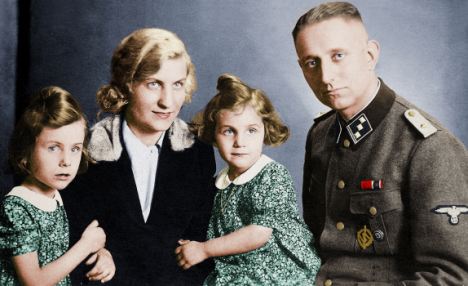
Hitler summoned his favorite architect to his mountain retreat. Speer and his wife became regular guests at the Führer's most intimate gatherings. Neither a party leader nor a minister, Speer was Hitler's personal confidant.
“The Führer simply adored Speer. You could not imagine how cheerful he became when Speer visited. He welcomed him unreservedly, as though a lover had arrived, and the practical work in hand suddenly ceased to matter. He often abandoned unfinished work for two or three days. We subordinates could feel that while Speer was there, he controlled the Führer’s time. The two immediately began sketching buildings, spending hours drawing plans and gazing at models. They were engrossed, adding and erasing each other’s lines. Seeing how well the two got along was positively enviable.” (Hitler’s adjutant at the time, R. Spitzy)
Speer established a studio near Hitler's mountain residence. A message arrived from the Führer: "I will commission architecture on the grandest scale ever seen in any age."
Able On-Site Leadership in Building 'Germania'
Germania. That was the name of the world capital to be built in Berlin. Speer was placed in overall charge of this plan to rebuild Berlin. The first structure was a new Reich Chancellery. Construction began in January 1938. Hitler had decided to hold the next New Year reception there in grand style. Speer was given less than a year.
"He had outstanding leadership ability. For example, he divided work among several companies, having them proceed simultaneously at different locations. This was a complicated method for the person overseeing everything, but without it the deadline could not possibly have been met." (Architect W. Schelkes, then working under Speer)
In the final phase of construction, over 8,000 workers carried out different tasks simultaneously. Speer closely monitored overall progress to ensure completion on schedule. When Hitler inspected the building two days before the deadline, all work was finished. The Führer hailed his personal architect as a genius.
The Mosaic Hall, the long gallery, the chancellor's office. Speer personally designed the writing desk for the Führer. He had the plans inscribed: 'All designs are based on the Führer's plans.'
This is what central Berlin would have looked like once Germania was complete: an enormous square, with a great hall for 150,000 people towering at its center. Beside it, the old Reichstag would look tiny. The armed forces' central headquarters, and the Führer's palace—grander still than the new Chancellery. Germania was scheduled for completion in 1950.
Urban Planning at the Expense of Jews
〈From 1939 onward, Jews were forcibly evicted to advance the expropriation of land.〉
Enormous numbers of homes were demolished for the urban development plan. The victims were 23,000 Jewish tenant households. As the official responsible for the plan, Speer issued many orders to evict Jews. In one document he asked subordinates to report on the progress of clearing 1,000 homes. The residential survey was so meticulous that the Gestapo went from house to house checking. First, Jewish tenants were exhaustively identified and listed. Then the administrative procedures for eviction were carried out with bureaucratic precision. Germans were to move in immediately after the Jews were evicted. For many Jews, the eviction order came without warning.
"It happened one evening as I stepped outside to see off a visitor. Two men marched up, asked my name and suddenly ordered us out. It was completely unexpected, and we were given no time at all. We packed only essential clothes into a suitcase and were deported to Poland. I was separated from my parents and brother. I never saw my family again." (W. Krisch, a Jewish deportee)
The eve of Führer Hitler's fiftieth birthday. (Voice from a television program of the time): “The east-west thoroughfare, part of the capital's reconstruction plan, opened on the eve of the Führer's birthday. The Victory Column has been given a new appearance.”
Once again, Speer met the deadline precisely. That day, he also had a gift for the Führer waiting at the Reich Chancellery: an intricate, four-meter-high model of a triumphal arch. Hitler was deeply impressed. It was based on a sketch he had drawn fifteen years earlier. Speer intended to build this arch in Berlin. It was spring 1939, with war approaching.
Successor as Armaments Minister
But seizure came before construction. Once World War II began, German forces advanced from victory to victory and defeated France.
[In June 1940, after the conquest of Paris, Hitler toured the city with Speer.]
The war dragged on and the number of fronts increased. Führer Hitler had little time left to immerse himself in architectural dreams. The armaments minister, Fritz Todt, was occupied with weapons production. Todt was an engineer distinguished for projects such as the autobahn. But a tragedy occurred in February 1942. [February 7, 1942: Armaments Minister Todt dies in an airplane crash.] It brought an unexpected turning point in Speer's life.
Hitler appointed Speer to succeed the deceased armaments minister. It was another extraordinary promotion. Surprised, Speer declined, saying he knew nothing about the field. But the Führer trusted the organizational ability he had already shown. The thirty-six-year-old Speer resolved to take on this heavy responsibility. “Let us work tirelessly in service to our fatherland so that the Führer may quickly recover from this deep sorrow. It is our labor that will lead Germany to victory. I pledge to devote all my strength to my duties.”
Military supplies were running short on every front. He presented a new policy to industrial and military leaders: industry itself would henceforth be responsible for procuring weapons and materials. He believed efficiency could not improve while the party and bureaucracy continued to interfere. The minister encouraged frank discussion, including experts who were not Nazi Party members. Immediately increase production of military supplies: Speer drew those around him toward this clear goal.
Only six months after taking office, Speer announced results that fulfilled Hitler's expectations.
〈‘The Führer’s demands on the armaments economy were high, and meeting the planned targets seemed exceedingly difficult. But over recent months, production has begun growing unexpectedly, already gaining momentum beyond the original targets. The latest productivity figures show no sector falling below its target. Some have reached twice the level the Führer expected.’〉
The Führer set the task, and Speer accomplished it. Their relationship was the same as when they worked on architecture. The young, capable armaments minister savored the intoxication of skillful command and management.
Armaments Factories under Pressure and Total War
<February 1943: the German Sixth Army is destroyed at Stalingrad.>
No matter how much weapons production increased, German forces were rapidly driven back on the Eastern Front. Repeated devastating defeats cost not only supplies but enormous numbers of troops.
⟨Order for Mobilization into Factories⟩
Engineers and skilled workers had been specially exempted from military service. Now increasing troop strength took priority. Mobilization orders swept through key armaments industries. Women filled the industrial vacancies. Hitler initially objected when Speer recruited women into the workforce, saying that slender German women should not be worked as hard as log-like Russian women.
Hitler openly promoted the use of concentration-camp inmates and prisoners of war as labor. Speer complied, thinking only of efficient production. At the time he wrote to SS chief Himmler: “Facilities in concentration camps should be kept to the bare minimum.”
As the military situation worsened, Propaganda Minister Goebbels and others began calling for 'total war.' Armaments Minister Speer's role was to lead total war in the economy. "No sacrifice is nobler than one made for the homeland. To supply weapons to our soldiers at the front, let us devote ourselves to our tasks more than ever. We must not merely fulfill our duties, but constantly surpass our previous achievements."
<Wife Margarete; Eva Braun> The countryside near Hitler's retreat. Speer's wife Margarete spent lonely days with Hitler's companion Eva Braun. The armaments minister was extraordinarily busy, accompanying the Führer to inspect new weapons. Speer was responsible for planning armaments. But without battlefield experience, he had little say over which weapons would be used. The Führer held the decision-making power instead.
“When it came to architecture, Speer could deal even with Hitler as an equal. Sharing the same interest, they had no superior-subordinate relationship or hierarchy between them. But once Speer joined the cabinet, there were naturally occasions when Führer Hitler simply dictated what he should do. He often had no choice but to obey orders that went against his wishes. So he began complaining about Hitler, something he had never done before. He said he was being treated completely differently from the old days.” (Architect W. Schelkes, then Speer's subordinate)
V2 Retaliation Weapon
The failure in missile development arose from Speer's unquestioning obedience to the Führer. Speer had originally commissioned research into small, inexpensive antiaircraft missiles. Then a large weapon caught Hitler's eye: the V-2 offensive missile. Hitler ordered Speer to give priority to this imposing weapon. The V-2 became Armaments Minister Speer's greatest failure.
Dora-Mittelbau concentration camp in central Germany. Prisoners brought here were worked mercilessly to produce missiles and other so-called miracle weapons. Disused mine tunnels became a vast underground armaments factory. The tunnels extended for twenty kilometers. From August 1943, 60,000 prisoners were forced to work like slaves in these caverns. One in three died from the harsh labor. When Allied troops arrived, all the factory equipment was dismantled.
“We were crammed into the tunnels for twelve hours and made to work relentlessly. The factory operated in shifts, twenty-four hours a day. The Nazis were putting great effort into those missiles. Prisoners were sent to the factory as long as they could walk unaided. Those who could no longer walk were shot or sent to another camp, probably to be killed there. Then more prisoners were brought in. The working conditions were terrible. That factory was a place that wore human beings out and destroyed them.” (E. Hanstein, then a prisoner at Dora)
A Troubled Technocrat
The military situation grew ever worse. For Armaments Minister Speer, there was not a moment's rest. He flew from one theater of war to another to hear soldiers' unvarnished accounts and apply them to armaments production. A newspaper in enemy Britain assessed him this way: “He could rise to prominence in any party. He is a born technocrat, an outstanding administrator and senior technical official.”
Speer, an able technocrat, knew more keenly than anyone that resource reserves were beginning to run out. In January 1944, he fell ill from overwork. A hospital outside Berlin became his office. Away from the workplace, he became increasingly troubled by rumors that Hitler was dissatisfied with his achievements and would soon dismiss him. Recuperating, he had no way to check their truth. Convinced Hitler had distanced himself from him, he finally sent a letter of resignation from the hospital. Hitler was surprised by this unexpected timidity in his capable aide and immediately sent an emissary to the hospital: I have certainly not turned against you. Encouraged by the Führer, Speer finally made it through his illness.
A Dying Armaments System
When Speer returned to work in May 1944, Germany's armaments system was already dying. Allied Flying Fortresses threatened German skies daily. The Americans now began a plan to destroy the lifelines of Germany's war industry in a concentrated air campaign. The primary targets were military fuel plants, followed by transport, the arteries of industry.
[In mid-1944, American bomber formations concentrated attacks on German fuel plants and other targets.]
Ninety percent of Germany’s military fuel facilities were ultimately destroyed. Speer sent Hitler an urgent report: ‘At this rate, fuel shortages will bring catastrophe upon the armed forces.’ The word catastrophe had finally escaped the armaments minister’s lips. But Hitler refused to accept his subordinate’s pessimism. Speer again immersed himself in doing his utmost as armaments minister.
In mid-1944, despite severe damage to factories across the country, German armaments production reached an all-time high. Speer's desperate efforts merely prolonged Hitler's already lost war by several more months.
〈“Our military strength is superior. Whatever difficulties may lie ahead, we have no doubt of ultimate victory.”〉
<In late October 1944, American troops advanced across Germany's western border.>
The Ruhr, the great industrial region of western Germany, was engulfed in heavy fire. That winter, with the outcome of the war largely settled, Speer toured areas where fighting continued. This footage of the time is being shown publicly for the first time. The armaments minister understood clearly: Germany had lost the war. In the time remaining, his task was to protect as much of its industrial foundation as possible from destruction, so that the country could be rebuilt after defeat.
Fierce Opposition to the Order to Destroy Industrial Facilities
⟨Hitler orders retreating German frontline troops to destroy industrial facilities.⟩
Toward the war's end, Hitler began an almost self-destructive campaign of devastation. Speer fiercely resisted the Führer's orders at this point.
"Only Speer could have pressed Hitler that far. He never gave up. If told no, he immediately recast the proposal. He also argued, 'We should preserve the factories for when we retake them from the enemy.' That was exactly what Hitler most wanted to hear. Speer's persistence persuaded him to postpone the destruction for a while." (M. V. Poser, then Speer's adjutant)
But finally the order came: destroy all equipment and facilities the enemy could use. March 19, 1945—the so-called scorched-earth operation. One of Speer's adjutants witnessed his reaction to the order firsthand.
“I had never seen Speer show so much anger. But he never lost his reason and never gave up. He immediately took action, determined that something had to be done.” (M. von Poser, then Speer's adjutant)
Speer immediately headed for Berlin. In his briefcase was a personal letter to Hitler. “My Führer, until March 18 I never doubted that our fortunes would improve. But I can no longer believe in the results of the duties we must perform. Your orders will deprive the people of the foundations of their livelihood. I earnestly beg you not to employ destruction against your own people. May God protect Germany.”
Open criticism of the Führer. At that moment, he was prepared even to face a charge of treason. But the Führer overlooked the letter and sent him from the Chancellery as though nothing had happened. Foreseeing Hitler's downfall, Speer said farewell. He was still only thirty-nine and felt he had to live on in post-defeat Germany.
A Mysterious Meeting
April 23, 1945. An aircraft flew from northern Germany toward encircled Berlin. Speer was making a sudden visit to the Reich Chancellery on an urgent mission. By then he should already have been acting separately from Hitler and preparing for his duties after defeat. What could this urgent purpose have been? The aide who accompanied him recalled it as follows.
"He would not have taken such a dangerous action without an extremely pressing reason. Speer told no one his reasons. But as someone who was close to him at the time, I consider the following possibility: Speer feared being chosen as Hitler's successor. It was not impossible. Even if he were to take part in rebuilding his defeated homeland, he was desperate to avoid becoming Hitler's successor. In any event, I think he flew to Berlin to discuss Germany after Hitler with the Führer himself." (M. V. Poser, then Speer's adjutant)
The Reich Chancellery. Its crumbling structure had once been Speer’s pledge of loyalty to the Führer. Now he was about to meet the Führer in the bunker as the end approached.
“I remember. Speer went into the study alone with the Führer, and they talked for a long time. Shortly afterward, Speer left. I do not know what they discussed. Hitler never mentioned Speer again.” (T. Junge, then Hitler's secretary)
If Speer had declined to become Hitler's successor, Hitler had accepted his wishes. In his will, Hitler named naval commander-in-chief Dönitz as successor.
The Guilt of His Friend Hitler That Speer Took On
In early May, after Hitler's suicide was announced, Speer addressed the nation from a Hamburg radio station.
“In this war, all the German people have shown magnificent unity. When humanity looks back on this war someday, our resolute stance will inspire admiration. This is not the time or place for sorrow or mourning the past. Only through persistent labor can we open the way to our future. May God protect Germany.”
At the war-crimes trial six months later, Albert Speer willingly acknowledged his guilt. Of Hitler's close associates, he alone sought to accept guilt for following him. He later recalled: “If Hitler had had a friend, it would have been me.”
After serving twenty years in prison, Speer’s life came to an end in 1981.