
Erwin Rommel
Rommel: National Hero, Desert Fox
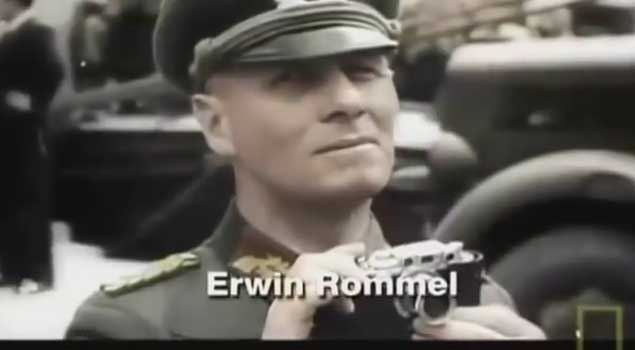
On October 14, 1944, a limousine hurried along the road. On the back seat lay a corpse. A war hero.
‘Telegram from the Führer’
The condolence telegram had already been prepared, and there was a funeral wreath. The man who had once made him a field marshal. A national hero. A tragic figure.
[Hitler and His Generals: Rommel, National Hero, Desert Fox]
Suicide ordered from above. A funeral that mocked the agony of death. Only the bereaved family knew the truth.
"I felt paralyzed. Rundstedt announced Father's death and left. He seemed like a ghost. We came to pay our respects on the Führer's orders." Rommel's son, Manfred Rommel
[Field Marshal Rundstedt, October 18, 1944] “To Field Marshal Rommel, who died an honorable soldier's death. Returning from the Normandy battlefield, he was seriously injured in a car accident. I felt dazed, as though fainting. I wished it would end quickly.”
Field Marshal Rundstedt lays a wreath from the Führer.
“A vile act was committed at the state funeral. The whole regime was a lie. It was horrifying.” Sister Isa Vermehren
A Hero's Loyalty to Hitler
The regime turned Rommel, victor of Tobruk, into a legend: a figure created by propaganda. A fatal pact with power. In September 1942 he stood at the pinnacle of his career. With the Soviet campaign faltering, the regime needed a victor. Hitler's favorite general was presented by Goebbels as 'a man admired not only by Germans but by the whole world.' A hero was born: the courageous soldier, the hero of Africa. He was an instrument of the regime.
<October 1942, weekly newsreel> 'Field Marshal Rommel receives his marshal's baton from the Führer.'
"Standing before Hitler, he looked strong and soldierly. Seeing him, I felt he was the finest of men. He was offering victory to the Führer." Wehrmacht soldier Ludwig Baumann
Hitler was his hero. Decorations signified favor and an incentive for achievement. Here was the Knight’s Cross of the Iron Cross. He already possessed the highest decoration: the Pour le Mérite, awarded for service in the First World War. After the war, he taught at an infantry school. Duty, obedience, fatherland: the outlook of an apolitical soldier longing for liberation from the Treaty of Versailles.
In March 1933, a scene was staged in Potsdam. The new chancellor Hitler took his oath. Rommel was moved. “For his greatness and strength, we are ready to fight at any time.”
Hitler took notice of Rommel. He had been impressed by Rommel's book Infantry Attacks. Rommel rose in rank. As commander of the Führer's escort battalion, he was present at the scene of victory. He wrote this about the Sudetenland.
<Rommel's letter to his wife> 'He leads the German people toward the sun. He has the power to attract people.'
Meanwhile, massacres began in Poland.
<Rommel's letter to his wife> 'I am allowed to attend the evening situation conferences and sometimes to speak. He is truly full of energy. I have been in his company many times. This trust pleases me more than my rank. The Führer seems energetic. There are two conferences a day. Yesterday I sat beside him.'
A few weeks later, Hitler attended a celebration with old comrades. A bomb had been planted at the venue.
⟨November 8, 1939: Hitler's voice⟩ “I have come to you at short notice, to spend another day together. For us and our actions. For a day important to the German people.”
He arrived early. It was proclaimed an act of divine providence. “Let everyone give thanks to God.” Rommel agreed.
[Rommel's letter to his wife]: 'The attack strengthened his resolve. I am fortunate to have witnessed it. No one would imagine an assassination succeeding.' He continued to rise in rank.
7th Panzer Division
“Hitler asked my father what he wanted. He asked for an armored division. The cavalry generals would probably have given him only infantry.” Rommel's son Manfred Rommel
Hitler agreed and gave him the Seventh Panzer Division. He created a legend with modern weapons. His troops crossed France. Sometimes he crossed the front alone in a tank. This is a soldier's personal footage.
"Rommel led from the front and sent the soldiers charging. For us young men he was the ideal commander, straight out of a military picture book." Wehrmacht soldier Meinhard Glanz
Even in the military picture book there was battle and death. His 'Ghost Division' appeared in unexpected places.
“He was unquestionably a charismatic commander. He could move his subordinates deeply. As a tactician he was imaginative. His military achievements cannot be separated from the historical course of events. For whom was this war fought, and what kind of war was it? It was waged under the criminal Nazi regime.” Wehrmacht second lieutenant Count H. Einsiedel
Rommel's division took many prisoners and caused many deaths. Africa presented a strange situation. Mussolini dreamed of recreating the Roman Empire. It was a disastrous failure. Mussolini asked for help. Hitler promised strong support.
[Rommel's letter to his wife]: 'First I received a new assignment from the army commander-in-chief, then met the Führer. It was an emergency, so I brought only what was necessary. It is an extremely large and important mission.'
Early in 1941, German troops landed at Tripoli. Soon a divisional song captured the mood: “Salt Tommy's soup; stir it once more to the beat of the drum; advance with Rommel.”
It began with a bluff. Rommel sent his few tanks around a parade route repeatedly. British spies overestimated his strength.
“Rommel was highly regarded. Everyone talked about him. The Italian commanders had lost the will to fight, so only Rommel could attack the British.” Italian second lieutenant Leonida Fazi
The Afrika Korps moved immediately. Once again, bluff made its strength seem greater. As it advanced, it raised clouds of dust. The Royal Air Force reported a large army moving east.
[Erwin Rommel, 1943]: "Although our strength was inferior, on April 6, 1941, we attacked near Mechili. Some forces headed toward Derna to control the desert roads and cut off the enemy's retreat."
Fighting in the Desert
The Desert Fox came into his own. The desert was ideal terrain for armored divisions. Within two months he reached the Egyptian border, astonishing headquarters' generals. Supply difficulties brought criticism of his command.
“A divisional commander spreads his formations over some 600 to 800 kilometers. The area immediately before him is only about five kilometers, obviously much smaller. That was his method. Many soldiers admired it, but I do not.” German armed forces lieutenant E. von Kleist
He was criticized in Berlin. Chief of the General Staff Halder noted: ‘Hopeless. We must restrain him.’ That task fell to the British at Tobruk. Rommel's assault on the fortress failed. Some said his ambition led him to treat soldiers as expendable. He saw it differently.
<Erwin Rommel> 'The attack at Tobruk came close, but unfortunately failed, and the fortress did not fall. Ending a six-month siege was a painful decision. I have not sacrificed German soldiers.'>
“He did not drive soldiers forward for victory alone. He simply endured the loss of men. I think his chief aim was advancement.” German armed forces soldier Ludwig Baumann
‘Rommel never forgot that soldiers’ lost lives meant grief and suffering for their families. He tried to minimize losses. His principle was to shed sweat, not blood.’ Wehrmacht soldier Meinhard Glanz
The legend of ‘war without hate.’
"They did everything they could for prisoners, and we therefore hold them in the highest respect. Their gentlemanly conduct honors Germany. Many dishonorable things were done at that time, but the Afrika Korps and Rommel were different." British second lieutenant S. Bradshaw
The desert was everyone's common enemy. Before a sandstorm, they say, everyone is equal.
⟨Erwin Rommel⟩ “In the heat of Africa, flying was difficult, and sandstorms plagued us. Water was scarce and food very limited. But German soldiers endured those difficult days.”
Propaganda showed idyllic scenes: bathing in an oasis, frying eggs on a tank. Both sides listened to Lili Marleen: “Are you there by the streetlamp, before the great gate outside the barracks...”
Bitter winter cold brought failure on the Soviet front. Rommel was exploited.
[Erwin Rommel]: "Our first attack took place on January 21 and dealt the enemy a severe blow. With no time to counterattack, the enemy suffered heavy losses."
Buoyed by optimism, the Afrika Korps continued eastward: from the minefields extending to El Gazala to the vicinity of Bir Hakeim in the south, then its greatest and final military success, the capture of Tobruk. War like a sports broadcast.
⟨Radio broadcast, July 21, 1942⟩ “5:51. The attack continues little by little. Amid enemy antiaircraft fire, a remarkable sight from above: smoke rises from the fortress of Tobruk. Destruction and death are being brought—a mushroom cloud is visible. The bombs have hit their target.”
Tobruk fell. Rommel understood his role—and was interviewed a few hours later.
[Radio broadcast, July 21, 1942] “Today came the honor of capturing the fortress of Tobruk. German and Italian servicemen performed superhuman feats, overcoming strong fortifications and minefields with remarkable skill. Even as soldiers fall, victory is assured.”
The spirited words were just what Goebbels had hoped for.
"Rommel was a battlefield hero. He also kept Germany supplied with an illusion: that victory was possible. And propaganda exploited him." Wehrmacht second lieutenant Count H. Einsiedel
Tobruk was captured in twenty-four hours. The victory was more important psychologically than strategically. Thirty-three thousand British soldiers were taken prisoner. It was a headlong charge to Hitler’s liking.
Promotion to Field Marshal
〈Radio broadcast, July 22, 1942〉“The Führer sent the following telegram to the commander: ‘Field Marshal Rommel, in gratitude for your leadership and your decisive deployment of forces, I promote you to field marshal as of today. Adolf Hitler.’”
“We heard the news on the radio—that he was being promoted to field marshal—and it spread quickly. He was as delighted as a child.” Rommel's interpreter, J. W. Armbruster
“We did not open any wine. We knew about celebrations, but held none. The war was still going on, and my father was always in danger of being killed.” Rommel's son Manfred Rommel
The road to Egypt seemed open—but Alexandria was still a hundred and fifty kilometers away.
“As a great victor, Rommel continued advancing toward Cairo and El Alamein. We thought Palestine was close. We believed Rommel would succeed, because he had been winning one success after another.” German Jew Inge Deutschkron
They advanced east along the Via Balbia, a product of cooperation: built by Italians, completed by Britons and used by Germans. Its name changed with the fortunes of war. [“ROMMEL WEC” (Rommel's road)]
The enemy was waiting at El Alamein. It was an ideal place for the British to halt the German advance. They built fortifications with minefields. The defensive line was several kilometers wide and fifty kilometers long, running from the Mediterranean across the desert to the Qattara Depression. It could not be outflanked. Any advance toward Cairo or the Suez Canal had to pass through it. This was the setting for the decisive battle. British commander-in-chief Auchinleck also had to fight the Rommel myth. A directive stated: “He is not superhuman. Belief in supernatural powers is undesirable. P.S. I am not jealous of Rommel.”
“Everyone talked about the Desert Fox, and headquarters was frightened. They deliberately played him down, saying he was not invincible. But no one believed them.” British soldier Douglas Waller
Rommel was a hero to Egyptians too. They awaited him as a liberator from Britain. Demonstrations were held in support of Rommel.
"When Field Marshal Rommel attacked, Egyptians regarded the Germans as liberators. People shouted, Long live Rommel! Our enemy's enemy is our friend." Abdu Mubasher, son of an Egyptian activist
The resistance centered on the Free Officers. Sadat, later president of Egypt, recalled: ‘We contacted the German General Staff and were always in agreement.’ That dream vanished in the noise of battle, and the German army halted. At a ceremony in Berlin, Goebbels noted: ‘We need figures like Rommel, admired by the people.’
“We do not recognize him. Anyone who worked for Hitler was also a criminal.” German Jew Inge Deutschkron
“It contradicted historical fact. Whether objectively or subjectively, this was the tragedy of Rommel's generation. They fell victim to the regime's propaganda and failed to recognize its inhuman aims early on.” German armed forces soldier Meinhard Glanz
The Decisive Battle of El Alamein
He became aware of the propaganda, but not of the person behind it. The decisive battle began at El Alamein.
Churchill brought a new opponent: Montgomery. Learning from his predecessor's failures, he gained overwhelming numerical superiority. The Afrika Korps faced annihilation. The only solution Rommel could see was retreat, but Hitler insisted on fighting to the end.
“Hitler's response, to fight to the last man, meant total annihilation. For Rommel, it was a tragic conclusion. A break with Hitler. He realized Hitler had absolutely no sympathy for the soldiers.” Rommel's secretary, Rolf Munninger
Rommel resisted. His trust in Hitler wavered. Despondency and visions of destruction. A farewell letter to his wife.
[Rommel's letter to his wife] “My love for you, my gratitude for our twenty-six years together, and my thoughts of Manfred. I prayed that God would protect you both. I lie awake at night, thinking desperately about a way out that could save the poor soldiers, a way to save ten thousand lives.”
“The day will come when Rommel is appreciated even more than he is now—when his retreat from El Alamein is valued more highly than his advance. He got everyone back to Tunisia.” Rommel's interpreter J. W. Armbruster
A journey of 3,000 kilometers, caught between American and British attacks. It was a final attempt to save his men.
“My father went to Berlin on his own initiative and proposed withdrawing the Afrika Korps to Hitler. That created distance between them. My father was thrown out of the room, but then summoned back.” Rommel's son Manfred Rommel
Defeat and Dismissal
In March 1943, Rommel left Africa. A hero could not be allowed to lose; he was dismissed. In May, the Afrika Korps surrendered. Footage of Rommel with Goebbels's children. An unemployed field marshal. He looks awkward.
“We sat and talked. He told me that the only information he could obtain was what newspapers and radio reported. I suppose he meant that he had been dismissed.” Rommel's secretary Rolf Munninger
Inside, he was despondent.
⟨Rommel's letter to his wife⟩ “We have as good as lost. Sadly, the fanaticism of those at the top amounts to madness.”
From 1942, the family lived near Ulm. A visitor in autumn 1943 was his old friend Strölin, mayor of Stuttgart.
"He heard of mass murder in Poland—and that Jews were being killed with poison gas. Those were the reports. Father could not comprehend it and shut himself off. How could one escape a situation in which the state itself was criminal?" Rommel's son, Manfred Rommel
Orders to Prevent an Allied Landing in France
Removing Hitler was unthinkable to him. Hitler entrusted him with preventing an Allied landing in France. He set about his task, but...
“He had lost his composure. He was completely different from the man he had been. It was never a matter of neglecting his duties. But Rommel had become an entirely different person.” Rommel's secretary, Rolf Munninger
A dark premonition of defeat. At headquarters in La Roche-Guyon, strategy was discussed. Should they continue a war on two fronts? Rommel had doubts. He repeatedly went toward the Strait of Dover, zealously installing defenses—almost as though escaping reality. The public expected him to appear energetic.
⟨Weekly newsreel, March 1944⟩ “Field Marshal Rommel at an operations conference. The German armed forces are fully prepared for the enemy landings.”
Rommel's headquarters was a gathering place for rebels. They were exploring a peace settlement on the Western Front led by the field marshal. And Hitler's assassination as well. Did Rommel know? Preparing for the invasion came first, but he thought differently.
[Rommel's letter to his wife]: “I am convinced that another fourteen days would be enough.”
“Across the Channel, Rommel's name still had an effect. I was surprised. I thought we'd had enough of him.” British soldier Douglas Waller
He was optimistic before D-Day.
[Weekly newsreel, March 1944] “(Rommel:) With our troops' fighting spirit and the new weapons supplied to us, we can calmly prepare for the coming battle. There is no need to worry about its outcome for a single second. We shall naturally succeed, and the British will not try again.”
‘People watching the screen must have found it strange, as I did. I did not recognize my father’s appearance and words. I was surprised that he spoke differently from the father I remembered.’ Rommel’s son Manfred Rommel
D-Day
The forecast for June 6 was bad weather. Rommel went home for his wife's birthday.
“On the morning of June 6, General Speidel telephoned and said the coast was in considerable turmoil. They could hear machine-gun fire and other sounds, but had no details. It might be an invasion. Father asked whether he should leave immediately and was told to stand by. He would call again later. Father packed his bags. An hour later, the telephone rang again, and he was told the landings had begun.” Rommel's son, Manfred Rommel
D-Day. As Rommel celebrated a birthday and Hitler slept, a massive invasion began. Once again, Rommel was absent from the front at a crucial moment. Contrary to expectations, the Allies landed in Normandy. German forces could not hold the coastline. The Allies established a bridgehead, and the outcome was decided. Rommel faced his North African enemies again: Montgomery and Eisenhower. Tanks heading toward Normandy became targets for air attacks. The situation grew increasingly hopeless. As German soldiers fought on with no prospect of victory, thousands were captured each day, and countless soldiers—even boys—were killed, Rommel and his associates made a political decision.
"For a long time he thought it was possible. He believed that if he told Hitler the military situation as it really was, the conclusion would follow." Rommel's son, Manfred Rommel
Hitler's concession was an illusion, and Rommel was sent out of the room. Rommel hesitated over Speidel's negotiations.
‘The question is whether the assassination plot was discussed. Shortly before his death, when the Gestapo surrounded our house, Father said that a dead Hitler would be even worse. He would certainly have opposed it.’ Rommel’s son Manfred Rommel
It was an illusion of justice in an age of tyranny.
“He was preparing, but not to join a plot to assassinate Hitler. He did think Hitler should be arrested. He was preparing to play the same role as Hindenburg if such a figure were needed after the war.” Adjutant Winrich Behr
There was little time for him to end the war himself. He broadened his support in the west.
"He and his commanders considered how to bring about a ceasefire on the Western Front, so that German troops could return to the border." Rommel's secretary, Rolf Müninger
Wounded
On July 17, he was in an open car on his way back from the front to headquarters. His aide later estimated the location to have been near Montgomery.
‘I was in the back seat. Around 6 p.m., the car reached Livarot. At about that time I saw eight fighter aircraft circling overhead. The lookout reported that two were coming along the road. I ordered the car driven as fast as possible. We headed for a park lane some three hundred meters away. But just before we reached it, the enemy aircraft—closed to five hundred meters and began attacking.’ Helmut Lang
“The soldier driving had his left arm blown off at the shoulder. The aide suffered a pelvic injury. A two-centimeter grenade had exploded. A fragment threw my father out of the car. People were astonished and delighted that he was alive. My mother said that he was wounded.” Rommel's son Manfred Rommel
Involvement in the Plot to Assassinate Hitler
Three days later, Hitler too was wounded in an assassination attempt. Schmundt, Rommel's friend and Hitler's adjutant, was also seriously injured. Rommel had gained access to Hitler through him. Ten weeks after the attempt, Schmundt suddenly died. Was Bormann involved? The assassination attempt offered an ideal opportunity for a purge. Rommel too was caught up in it. Bormann's report at the end of September: “Rommel knew. He had offered his cooperation to the government that would follow the assassination.” It sealed Rommel's fate. Goebbels also wrote: “Rommel was not involved in the plan, but appears to have known about it. To me, this is the greatest disappointment.” He was no longer Hitler's favorite. Senior figures jealous of Rommel devised a “Court of Honor,” a military tribunal preceding the People's Court.
“The Court of Honor was a complete farce. A genuine tragedy. A German general being disposed of under pressure from those around him. When Field Marshal Rundstedt left headquarters in France, he too said he was fed up with Hitler. Yet he presided over that Court of Honor. It shows how immense the pressure was, how Hitler had destroyed the foundations of the army.” Rommel's son, Manfred Rommel
Rommel, at home, was caught in a trap.
“The Gestapo were around the house day and night. My father said he might be shot. He called the guards responsible for the house's security. Every day it was clearer that he was being drawn in. He even said he might not be alive that night.” Rommel's son Manfred Rommel
It was 10 a.m. on October 14, 1944. Rommel walked with his son. A train approached Ulm, carrying funeral wreaths. Preparations for a state funeral were complete. A condolence telegram had already been drafted: “Mourning the death of your husband...” Around noon, a black limousine arrived at Erwin Rommel's home.
"After the greetings, they said they wanted to speak privately with the field marshal. Then General Burgdorf came in—and General Maisel went outside." Rommel's son, Manfred Rommel
Suicide
Rommel was accused of complicity in the assassination attempt. He was forced to choose between suicide by poison and the People's Court, which would also endanger his family. For his family's sake, Rommel chose suicide. “My heartfelt condolences—Adolf Hitler.” The regime ordered the man it had made a hero to kill himself. In this staged death of a hero, Rommel played no part.
[October 18, 1944: Field Marshal Rundstedt] "Dear Rommel. On the orders of the Führer and headquarters, I have come to express gratitude and farewell. We offer heartfelt sympathy to your surviving family. Your heroic death reminds us to fight until victory."
"I consider his contradictions as a human being. It was an age in which behaving honorably was extremely difficult. Am I better than the people of that time? We must consider what we would do under the same conditions." Rommel's son, Manfred Rommel. [End]