
Hitler
About This Chapter
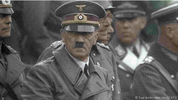
Surely everyone knows Hitler. The Hitler shown at the upper left of this page is the man himself.
Examining Hitler's upbringing and his rise to power reveals that evil forces did not run rampant simply because a cunning madman happened to gain power. The persecution of Jews, for example, did not begin with Hitler. It was a current that had existed for centuries, not only in Germany but in other European countries as well.
Although this is not strictly an accurate description, Japan is an island nation populated largely by a single ethnic group whose people look much alike. The idea of excluding another ethnic group because its members look different is therefore unfamiliar, and many people would probably agree that persecuting or despising a particular people is “wrong” and “contrary to humanity.” Not so long ago, pages of The Diary of Anne Frank were torn out in some Japanese libraries. As the chief cabinet secretary said at the time, the tendency to despise particular ethnic groups is very weak in Japan.
For example, I know that the Ryukyuan and Ainu peoples exist in Japan, but I have never seen Ainu people with my own eyes. Yet these peoples are Japanese. If I had opportunities to meet them in everyday life, or lived in such a region, I would probably think of them as people with an unfamiliar, minority appearance. I mean this in exactly the same sense as noticing a foreigner on the street whose appearance does not seem Japanese. But many modern Japanese people tend, in most cases, to feel nothing beyond that. In that sense, they are fortunate.
Yet in regions where many countries share borders across a vast continent, there exist, alongside ethnic diversity, sensibilities entirely different from those of Japanese people—sensibilities difficult for Japanese people to imagine. When these have existed for generations, changes in such currents are slow and sometimes involve much bloodshed.
In the 1930s, the machinery of fate in Germany and its European neighbors did not begin to go wrong simply because of one madman's dream. The hatred of both the people and their leaders converged at one point and erupted like magma. Its torrential flow drove the great wheel of fate, sending it spinning out of control.
It was not that Hitler alone was evil and infected everyone else with it. In a turbulent age, a man skilled at winning hearts appeared before people suffering hunger and cold who longed for a strong leader. When they came together at the right moment, history's most terrifying violent organization was born. Hitler merely awakened people's evil side. The acts committed and consequences brought about by that awakened side were so enormous and tragic that Hitler remains deeply engraved in people's memories and history as a symbol of “evil.”
And those aspects still exist within people’s hearts, in every nation and among every people.
This chapter transcribes a documentary tracing Hitler's life on the basis of historical facts.
English translation:
Who does not know Hitler? The Hitler you see in the upper left corner of this page is him.
If we unravel Hitler's background and the process that led to his seizure of power, we can see that he was not simply a cunning madman who was lucky enough to come to power and was overrun by evil forces. For example, the persecution of the Jews was not started by Hitler. It was a trend that had existed for centuries, not only in Germany, but in the rest of Europe as well.
In the island nation of Japan, where there is almost a single ethnic group with almost the same appearance, the idea of excluding another ethnic group with a different appearance is unfamiliar, so the idea of persecuting or despising XX people is considered to be "wrong" or "against humanity". Many people will agree with me. In the not-too-distant past, there was an incident in Japan where the pages of the book "The Diary of Anne Frank" were torn out in some libraries. As the Chief Cabinet Secretary said at the time, Japan has a very low tendency to despise certain ethnic groups.
I know that there are Ryukyu people and Ainu people in Japan, but I have never seen Ainu people with my own eyes. However, these people are Japanese. If I had the opportunity to come in contact with them on a daily basis, for example, and if I lived in such an area, I would consider them to be people with an unfamiliar (minority) appearance. That is exactly what I think when I see a foreigner on the street who does not look Japanese. However, most modern Japanese tend not to feel much more than that, and in that sense, we are blessed.
However, in a huge continent with many countries bordering each other, as well as ethnic diversity, there are sensitivities that are completely different from the Japanese, sensitivities that are difficult for the Japanese to imagine. When it has existed for generations, the changing of the tide is slow and sometimes involves a lot of bloodshed.
In the 1930s, the wheels of fate of Germany and its European neighbors were not set in motion by the dreams of a single madman. The hatred of both the people and their leaders was concentrated in a single point and erupted like magma, and the raging flow of that magma turned the giant wheel of fate and sent it spinning out of control.
It was not that Hitler alone was evil and the people were infected by his evil. In a time of upheaval, a man skilled in capturing the hearts and minds of the people, who longed for a strong leader in the midst of hunger and cold, came together in a timely fashion to create the most fearsome group of violence in history. Hitler only awakened the evil side of the people. The things that this awakened side did and brought about were so enormous and tragic that it has left a strong mark in people's memory and history as a symbol of evil.
And this aspect of Hitler still exists in the minds of people of all nations and races.
This chapter is a transcription of a documentary about Hitler based on historical facts.