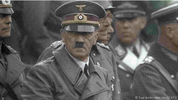

Heinrich Himmler
The timid Nazi leader who headed the SS and police
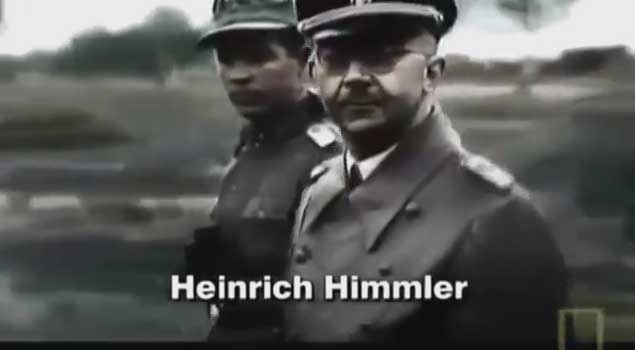
The Nazi SS. A small organization that had once been no more than Hitler's bodyguard was transformed by Heinrich Himmler into a vast apparatus of power. The man who drove the German people into a deadly struggle. The man who selected those to be exterminated and deployed the killing squads. This seemingly timid, quiet man was the executioner trusted by the Führer.
〈[Bavaria, Germany]〉
Bavaria in southern Germany. Heinrich Himmler grew up in an environment steeped in morality, order, and education. Nothing in his upbringing offers any clue to explain his later cruel ideas and actions.
He was born in 1900 into a middle-class German family. His parents were moderate Catholics who valued morality and good manners. As a boy he attended a prestigious school that had produced many politicians and scholars. His parents spared no effort to give their son a good education. His father, a teacher, particularly valued education's power to shape character. At school Heinrich was an unremarkable boy who liked history. His home was intellectual and loving. There was no experience that might have warped his young mind. Yet people can still twist their own minds and plunge into crime. Himmler's life would become a terrifying example.
The First World War began in the year Himmler turned fourteen. Like many boys, he dreamed of becoming an officer. But he was still too young to go to war. In June 1917, he finally graduated early and volunteered for military service. Himmler never experienced combat at the front. Before he finished training, the war ended, and Germany was defeated. Young Heinrich regretted having been unable to distinguish himself as a soldier. Thereafter, an unrealistic fascination with war and violence began to lurk in his mind.
Enthralled by Hitler’s Charisma
[1923]
Himmler can be seen among those in Hitler's Munich putsch of 1923. What attracted him was the Nazis' openly antisemitic ideology.
〈“Eradicate the Jews. Silence the insolent Jews. To overthrow and exterminate the traitor Judah is our sacred mission.”〉
In 1926, Himmler was still an obscure figure among the Nazis. He served as deputy commander of a small organization under the storm troopers: the SS, Hitler’s personal bodyguard of only a few dozen men.
〈[1927]〉
Hitler speaking in Nuremberg in 1927. Himmler stands behind him. As Himmler came into close contact with the leader, he began falling under the spell of Hitler's charisma. Ambition grew in him. He decided to rise to power using the small organization called the SS as his base.
Himmler's Ambitions
〈[1929]〉
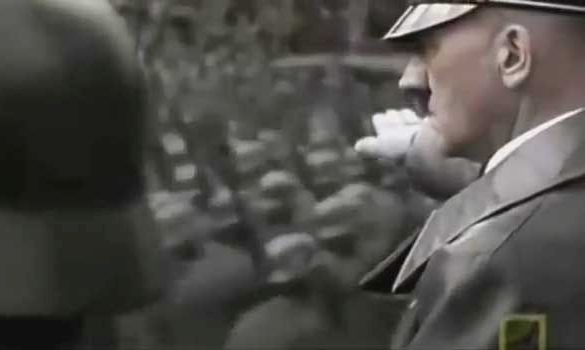
His first opportunity came in 1929. Himmler was appointed Reich leader of the SS, which numbered about 280 men. Compared with his ambitions, it was still an insignificant position. At a rally shortly afterward, Himmler stood with senior figures to watch the parade. He was edging steadily closer to power.
(T. Junge, then Hitler’s secretary) ‘The Himmler I remember seemed somehow uncertain and shy. He was neither a military type nor a ruthless commander type. His manner and appearance were those of a timid petty bourgeois.’
(Former concentration camp prisoner M. Holbæk): "At first glance, Himmler looked like a harmless, safe person."
(M. Bormann Jr., son of Hitler’s aide Bormann) ‘He was rather colorless, almost unmemorable. I think he was pleasant to the people present.’
(E. G. Schenck, then a Waffen-SS physician): “I have no impression of him at all.”
From the late 1920s onward, power struggles within the Nazis grew increasingly fierce. Yet Himmler's rise went unnoticed for some time. Inconspicuousness was his weapon. On his dagger he had engraved a Prussian military maxim as his motto: [A person's true worth is not in outward appearances.]
The Purge of Röhm and the SA
In 1933, soon after the Nazis took power, a power struggle erupted that shook the regime. At its center was Ernst Röhm, chief of staff of the Nazi SA. [SA Chief of Staff Ernst Röhm] With three million members, the SA had grown into a force threatening Germany's regular armed forces. Röhm aspired to control Germany's military. Meanwhile, the defense minister forced Hitler to choose: would the country's army be the regular armed forces or the SA? There were only two alternatives. Röhm acted with complete confidence. At the time, even Hitler could probably not have commanded an army of three million. Röhm called the SA the brown people's army, after the color of its uniforms, and spoke of the need for further revolution.
〈“Our organization will continue as before. The Führer has charged us with being the guarantors of the revolution. We will assuredly continue to fulfill our mission.”〉
Contemporary footage conveys Röhm’s popularity as a leader. Apart from Hitler, no one was so revered by the people. Hitler tried to rein in the storm troopers, beginning with a relatively moderate speech.
["Men of the SA, SS, and Hitler Youth. The army bears the people's weapons, but what you bear is not weapons. You bear the political will of the German people. Our sole purpose is the rebirth of a great Germany."]
Behind the scenes, however, a scheme was taking shape. When the Führer ordered the purge of this old comrade, Himmler helped prepare it. The SS was part of the SA, and Röhm had been Himmler's superior for years. When Himmler first joined the Nazis, Röhm had influenced him even more than Hitler. But he had already calculated whom to follow from now on.
〈July 1934: SA Chief of Staff Röhm executed for allegedly plotting rebellion〉The SS carried out the purge. Röhm was shot, and many other SA leaders were murdered.
⟨[1934] “Without any hesitation, we carried out the duty we were ordered to perform. We stood our erring comrades against a wall and shot them. We will never speak of this matter again. But if ordered, we will take the same action again.”⟩
<Hitler: 'Several months ago, we decisively eliminated a disturbing movement that had emerged within the party.'>
The Super Army: Deification of the SS
Röhm's purge left no leader standing between Himmler and the Führer. Taking advantage of the SA's weakened position, Himmler transformed the SS into the Nazis' super-army. He clothed it in a mystical aura unlike that of any previous military organization.
["For thousands of years our ancestors have built temples to God on this castle hill. Quedlinburg, home to the spirit of the Germanic people, is worthy of becoming the Germans' sacred ground."] In 1936, Himmler acquired a Roman Catholic cathedral and designated it a site for SS ceremonies. The officers who gathered there indulged in the fantasy that they were a brotherhood entrusted with a sacred mission. Heinrich Himmler sought to revive tenth-century Germany and the myth of Henry I's glory and victory.
["We advance unceasingly with this truth in our hearts: Henry I's noble spirit and political legacy have been inherited by our Führer Hitler. For Germany, for Germania, in thought, word, and deed, we pledge boundless loyalty to the Führer."] In this imaginary kingdom, what the Nazis called National Socialism was portrayed as a historical inevitability. Himmler, presiding over the kingdom, declared the SS the elite who would forge Germany's future. A chosen elite: this conviction gradually transformed the SS into perpetrators of terrifying violence, knights of Nazism without doubts.
["Following immutable laws, we shall march on without end: as an order of Nordic Germanic knights, as a community sworn to National Socialism, along the road to the distant future stretching before us."]
1934. The SS formally became independent of the SA. Over the next ten years, Himmler devoted all his energy to expanding it. His ambitions fitted perfectly with Führer Hitler's war plans. ⟨September 1939: The Second World War begins. Armed SS units go to war alongside the army.⟩
Among Hitler's inner circle, Himmler was one of those who enthusiastically welcomed war. War offered the very opportunity to display his power. ⟨In 1940, the fully armed Waffen-SS appeared. In just one year, it expanded to 110,000 men.⟩ By 1936, Himmler had secured not only leadership of the Nazi SS but also the position of chief of the German police. The police state developed rapidly. The police under Himmler's control bared their teeth at the vulnerable. This footage is from German-occupied Poland. A policeman hands a young man a Jewish star emblem. An unremarkable scene, but in effect a death sentence.
Running the Concentration Camps
〈‘Jewish residential district’〉Once the war began, concentration camps multiplied. At Theresienstadt in the Czech lands, an entire town became a camp. Jews and others targeted by the Nazis were confined there. The SS made enormous profits from unpaid labor. If the number of survivors dwindled, they simply had to be replaced. This girl did not yet know what the near future held.
Himmler earned the Führer's deep trust. An invitation to the mountain retreat marked him as an important confidant. His SS had now swollen into a vast power structure, virtually a state within the state.
(T. Junge, Hitler's secretary at the time): “At a meal with his close associates, Hitler once brought up the concentration camps. As far as I know, that was the only time he and Himmler discussed them in front of others. Hitler praised them as exceptionally well-designed institutions using an elaborate system to reeducate people. As an example, he asked Himmler whether it was true that a habitual arsonist was responsible for fire safety in a camp. Himmler immediately replied proudly that this meant there was no need to worry about arson anymore. The listeners were deeply impressed. Even though it was forced labor, they felt the camps were skillfully run with an understanding of human psychology. Everyone looked at Himmler with respect and admiration.”
Himmler's speech at a party rally: “Of course, concentration camps mean a severe deprivation of freedom. They are places of harsh labor to create new value. Inmates are compelled to learn and practice a proper way of life. Cleanliness, impeccable nutrition, and strict but fair treatment: the camps' motto shows people the path to freedom. What they must learn is obedience, diligence, sincerity, order, cleanliness, good judgment, honesty, self-sacrificing service, and love of the fatherland.”
The Old Castle at Rebertsburg
Favored by the Führer, Himmler played the monarch within his organization. In 1941, he had the old castle at Wewelsburg remodeled at enormous expense. It became an SS castle filled with fantasies of a gloomy kingdom. Himmler and the SS leadership became increasingly absorbed in mystical rituals glorifying themselves as heroes. A marble plaza commemorated the spirits of SS men killed in battle. It was concentration camp prisoners who built this sacred castle. A banner over the worksite read, “You have the Führer to thank for being able to work here.”
M. Holbeck, former concentration camp prisoner: "We were taken into a great marble-floored hall used for SS ceremonies. Our job was to polish the marble floor. We crawled over it, polishing by hand without a break."
A list of prisoners subjected to forced labor at Wewelsburg. Though this was not a so-called extermination camp, most of them died nonetheless.
(Former concentration-camp prisoner M. Holweg): “Once the castle was finished, we were sent to build housing for SS members. The SS leadership took great care over their men's living conditions. Meanwhile, the camp into which we were crammed was scarcely fit for human survival. People collapsed one after another in the appalling conditions. One statistic for 1943 puts the death rate at 63.7 percent. More than twenty people I knew died there.”
Rule by a superior Germanic people over inferior races: Himmler put this fanatical ideology into practice through unrestrained violence. 〈‘We regard other peoples only as our slaves and do not care whether they starve. If ten thousand Russian women laborers collapse building an antitank ditch, it means nothing to me. My only concern is whether the ditch is completed.’〉
Himmler's Top-Secret Order
When the German-Soviet war began, Himmler's secret orders were carried out behind the Eastern Front. Jews, communists and other Nazi enemies were murdered en masse by SS and Security Police mobile units. Himmler had once vomited while inspecting a shooting site. After that he even worried about the nerves of his killing squads. Rumors of the terror spread quietly.
(E. G. Schenck, then a Waffen-SS doctor) ‘A Security Service task force also came to the hospital where I worked. Its purpose, of course, was to kill all the Jews. First, posters appeared: “Jews must register. They will be moved to another safe location.” Many unsuspecting people registered. There were Jewish girls employed as assistants around me, too. They did their work properly and were treated relatively well in matters such as food. I had opportunities to speak with them a little and thought them pleasant girls. But they, too, suddenly disappeared, and later I learned they had been shot. Their bodies had been thrown into a nearby ravine.’
The Final Solution and Human Experiments
<[January 1942: the Wannsee Conference coordinated the 'Final Solution' to the Jewish question]> Mass murder became a state crime. Construction of extermination camps had already begun before the conference. Himmler wrestled with how to carry out the Final Solution—the extermination of the Jews—efficiently. One killing apparatus devised used exhaust fumes. When such devices were commissioned, the word 'killing' appeared nowhere in the orders. Zyklon
(H. Münch, then a Waffen-SS doctor): "What we did to the people in the camp was selection, not killing. Selection certainly was an act that led people to death. But for those destined to die anyway, it was a better choice. Their end might have been more miserable. In that sense, one could even call it a more humane death. As I saw it, all those Jews were a kind of dispirited people who had lost interest in living. Many starved to death, but not because of the food. It was not that there was no food. Even in terms of calories, there was no necessity for them to die. They died one after another because they had lost the will to live. All we did was give those emaciated Jews dying miserably a better death through selection."
Among those engaged in mass murder, ruthlessness became a duty, and suppressing emotion became proof of strength. Secretly filmed footage from Auschwitz. Children were subjected to human experiments by the camp physician, Dr. Mengele. Some miraculously survived.
(E. Reichenberg, a prisoner subjected to human experiments): “They came every week without fail and used us as experimental material. Eventually I was taken to the research building, where I was experimented on under constant surveillance. They injected some liquid directly into my throat. Immediately my neck swelled, and I suffered pain and high fever. I felt terribly sick and vomited repeatedly. I have been like this ever since. I cannot produce any voice at all.” (Author's addition: The interviewee holds a device against his throat and speaks in a harsh artificial voice, like a computer in a science-fiction film.)
(V. Alexander, a prisoner subjected to medical experiments) ‘My back and both arms are covered in scars from experiments and stitching. They are dreadful memories. The camp was filthy, so the wounds quickly became infected and filled with pus. In terrible pain and fear, we could do nothing but scream. I think that is what a place called hell is like.’
(M. Offer, a prisoner subjected to medical experiments) ‘I was injected with poison. I do not know what it was. But afterward I was left with clear physical disabilities. Even now, my body will not stop shaking. I have seizures resembling epilepsy. My life has been shattered ever since.’
Atrocious crimes masquerading as science. One experimental question, for example, was what effects high-altitude flight would have on the human body. Prisoners were confined in a chamber where air pressure changed rapidly, so that doctors could observe them struggling as they died.
Himmler's Abnormality: Grotesque Furniture
["We have taken no unnecessarily brutal or harsh measures. We Germans maintain proper conduct to the end, even when dealing with subhuman beasts."] At the time, Himmler's residence displayed evidence of how he treated prisoners.
(M. Bormann Jr., son of Hitler’s aide Bormann) ‘When I was little, I once played in the attic of Himmler’s house. That was where I saw them. The attic was cluttered with various pieces of furniture, and among them were several made from human bones. I clearly remember, for example, a little three-legged table. Each leg was a human femur. Then there was—perhaps you would call it a kind of chair—a stool-like piece made by combining bones from around the human pelvis. There was also an electric lamp. An adult nearby told me its shade was made of human skin. And a large handwritten book. It was Adolf Hitler’s Mein Kampf, and I was told that its cover, too, was skin from a human back.’
Autumn 1944. Even as German troops suffered defeat after defeat on the Eastern Front, the stream of people heading to the camps never ceased. Himmler's empire was maintained in secret and continued to expand. However widely rumors of slaughter circulated, no one could stop him. But the day when Himmler and his associates' crimes would be exposed was drawing near. ⟨January 1945: Soviet forces begin a fierce offensive, approaching Berlin from the east.⟩
Appointment as Supreme Commander in a Crisis: Rebellion
Late in the war, the Führer appointed Himmler commander-in-chief of the Home Army. It was his first military title; in a sense, his youthful dream had come true. But Himmler’s scant military experience made it clear that he was not fit to command. German forces were driven into ever deeper trouble. Pleading illness, Himmler withdrew to the outskirts of Berlin and handed his command duties to another general. He realized defeat was now near, but tried to keep the public from recognizing it. ‘We shall impress upon the enemy what enormous sacrifices even a single step into Germany will entail.’ 〈From September 1944 until defeat, males aged sixteen to sixty fought in the Volkssturm.〉
Himmler himself gave up on the unwinnable war. Seeking to survive, he explored peace negotiations. Through the SS intelligence service, he secretly met Count Bernadotte, the Swedish Red Cross representative. 'I first met Himmler on February 14, 1945, at a residence outside Berlin.'
Unauthorized negotiations with the West amounted to treason against the Führer. Yet with defeat imminent, Himmler's loyalty faltered. Revealing his timidity and calculation, he continued secret contacts with the West.
Flight — An Offer of Unconditional Surrender
[Berlin] April 20, 1945, Führer Hitler's 56th birthday. His inner circle gathered to celebrate in the bunker beneath the Reich Chancellery. Everyone could see that the end was near. From that day on, each had to decide how to face defeat. Himmler went into hiding. Concealed in an acquaintance's house north of Berlin, he devoted himself to making peace, as if he had forgotten his former self. Astonishingly, he even attempted negotiations with representatives of Jewish organizations. He wanted to cooperate with Jews to end the war. There was no prospect of such an audacious proposal being accepted. Growing desperate, he approached Count Bernadotte again. His proposal was that Germany make peace with the Western powers and continue fighting the Soviet Union. The Allies did not answer. Instead, the radio reported: “Himmler has offered unconditional surrender to Britain and America.”
(A. Axmann, then Hitler Youth leader): “When the Führer learned what had happened, he said it was his greatest disillusionment and dismissed Himmler from all his positions. Then Hitler added: He betrayed me, but the Hitler Youth have stood by me to the very end.”
Flattery and Servility
Kalkhorst Castle in northern Germany became Himmler's last residence. There he learned simultaneously of Führer Hitler's death and the order stripping him of power. He realized that he had lost his power base and was completely isolated. The war was not yet over. To win Western favor, Himmler promised to release some 15,000 Scandinavian prisoners. Finally rescued from their nightmare, they still had to travel through areas where fighting continued. Thus, even with the war's end in sight, many prisoners lost their lives. In the final days before defeat, Hitler's will made naval commander-in-chief Dönitz head of state. A hastily assembled government took shape.
(K. Tettelbach, then a German General Staff officer): “When something resembling a government had been formed, people came sidling up to curry favor. Himmler was among them. Field Marshal Keitel was particularly open about his disgust. He told Himmler to disappear. Faced with such undisguised condemnation, Himmler slipped away.”
Final Flight: Suicide by Poison
[May 8, 1945: President Dönitz announces Germany's unconditional surrender.] As Germany prepared to accept unconditional surrender, Himmler was trudging near the Elbe. Accompanied by only a few subordinates, he attempted to escape on foot. He carried false identification, had shaved off his mustache, and wore an eye patch. Blending into countless defeated soldiers, they went unnoticed for a time.
Peace returned to Europe, and Himmler's end approached. British forces arrested Himmler and his companions and sent them to a prisoner-of-war camp. His identity had not yet been discovered. Somewhere in this crowd was Heinrich Himmler. The two aides who had followed him to the end were brought before the camera. Afterward, they were told that their superior had killed himself.
On May 23, 1945, Himmler swallowed poison. A soldier who witnessed it reported: "We were not told it was Himmler, only that he was an important person. The man who came in was not elegantly dressed, but a shabby soldier wrapped in a blanket over his underwear. I recognized Himmler immediately. I pointed to a couch and ordered him, 'Sit down and undress.' 'You don't know who I am,' he said. I replied, 'You're Himmler,' and repeated the order. He glared at me for a moment, then lowered his eyes and did as he was told. The doctor and regimental commander came in and began the usual examination, looking for concealed poison. They looked between his toes, under his arms, even inside his ears. They examined his hair, and finally his mouth. At the doctor's command Himmler opened his mouth, stuck out his tongue, and moved it up, down, and sideways. But the doctor was not satisfied and ordered him to open his mouth beside the lamp. The doctor tried to put a finger into his open mouth. At that moment Himmler bit the doctor's finger and crushed the poison hidden in his mouth. I thought, 'He's beaten us.'"
The Nazi leader who had built an empire of darkness was buried wrapped in a rough blanket. He was forty-four.