
Hermann Wilhelm Göring
Göring: The Man Seen as Hitler's Successor
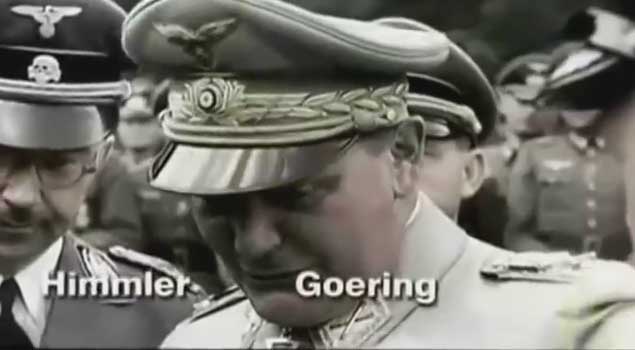
Hermann Göring. In Germany's Third Reich, he was second only to Hitler. A man of bombastic words who used his position to enrich himself. Dressed in flamboyant clothes, he played the role of a Nazi potentate: President of the Reichstag, commander-in-chief of the Luftwaffe, Reich Marshal. Yet his life, adorned with such glittering titles, ended as a defendant in a war-crimes trial.
Nuremberg interpreter E. Wiberal: "He unquestionably had something that attracted the masses. Perhaps he possessed an outstanding intellect. But conscience, or any ability to distinguish right from wrong, was completely absent."
Actress R. Müthel: "Göring was fat and always covered himself in decorations when meeting people. I think he would have wanted to be an actor if he had not become a powerful man."
Göring's nephew K. Riegele: “For us relatives, he was truly the head of the family. Whenever a problem or worry arose, someone invariably went to him. We would stand almost at attention, as it were, awaiting his decision.”
W. Krupinski, then a fighter pilot: ‘To a young lieutenant, he was an idol, a fighter pilot decorated for valor in the First World War. But that respect eventually disappeared.’
Hermann Göring was born in 1893 to a wealthy Bavarian family. His parents showed their son little affection. He spent his childhood with his mother and her lover. Neglected as a boy, he often escaped into a world of his own. Seeing her unchildlike son, his mother predicted that he would become either a great man or a great criminal. At military preparatory school, ambition and initiative took root in Göring’s heart. He found his goal: to become a soldier. Living apart from his family was also a relief. With excellent grades, he became an officer cadet and proudly donned his uniform.
In 1911, he passed the officer-cadet examination with one of the highest scores. Two years later, he was commissioned as a second lieutenant in an infantry regiment. Here is Göring at that time, his heart stirred by dreams of adventure and honor.
When the First World War began, he was among the first to volunteer for the air force. He sensed that the skies offered more enticing adventures than the ground. After pilot training, he first experienced aerial combat in 1916. He advanced rapidly toward becoming an elite pilot. His courageous sorties earned him the highest military decoration, the Pour le Mérite.
Defeat, however, changed everything. The Treaty of Versailles stripped Germany of its military strength. Like many soldiers, Göring felt betrayed. An unemployed serviceman, he clung to flying. He piloted air shows and cargo flights, eventually finding employment with a Swedish airline. While in Sweden, he fell in love with a countess. Carin von Kantzow was five years older than he and already had a child. But she, too, was gradually drawn to the charm of this reckless young German. Persuaded by her lover, she finally abandoned her husband and child. In 1923, the two went to Germany and married. Göring was in the last year of his twenties.
Meeting Hitler and Drug Addiction
Returning to his homeland after a long absence, he found the streets shaken by discontent with the Versailles settlement. Amid it, Göring noticed a remarkable individual: Adolf Hitler. Göring was impressed by Hitler's speeches.
He joined the fledgling Nazi Party. Delighted to gain a First World War hero, Hitler made him commander of the SA. In uniform, Göring recaptured the image of his glorious military days.
Göring displayed a soldier's ability to command. But this time the mission was not to defend the country. Their aim was to seize power through subversion. Yet the Munich Putsch of 1923 failed completely. Police gunfire seriously wounded Göring in the thigh.
He escaped arrest and went into exile. Hitler went to prison. In this bleak period for the Nazis, something happened that would cast a shadow over Göring's entire life. Morphine used to treat his wounds made him a drug addict. He became violent when deprived of it and spent a time in a ward for dangerous psychiatric patients. His medical records contain words that seem to predict his later character: suicidal, depressive, self-centered, and hostile to Jews. While fighting his addiction at his wife's family home, Göring waited for a chance to return to Germany.
Hitler's Cabinet Is Formed: Göring Joins the Government
Released at the end of 1924, Hitler immediately sought a comeback. This time his means were propaganda and agitation: taking over parliament legally. Göring remained abroad for a while longer, then rejoined the Nazis after an amnesty in 1926. With them, he finally began climbing the ladder to the power he desired.
Göring's nephew K. Riegele: "When my uncle met Hitler in 1923, he formed a firm conviction that Germany needed Hitler to escape its miserable postwar condition. He repeatedly told us no one else could lead the homeland. So I do not think his loyalty to Hitler was ever merely superficial."
[January 1933: Hitler's cabinet formed.]
January 1933. Hitler finally secured the chancellorship he had long sought. At this point it was still a coalition of the Nazis and the German National People's Party. Vice Chancellor Papen dismissed Hitler as a mere ornament of the new government. But Hitler had already devised his next plan for Nazi dictatorship. Göring received a cabinet post in the new government.
⟨1933: Göring joins the cabinet⟩
On the night the new cabinet was formed, Nazi supporters staged a grand victory parade in a Berlin square.
(Note: Göring's policy declaration) “When I agreed to head the Interior Ministry, I knew how difficult a task I was taking on. I intend to sweep away, with an iron broom, the political aliens who have insinuated themselves into positions of power.”
A month later, the Reichstag fire provided the occasion to put Göring's vow into action.
Former concentration camp prisoner H. Gasparitsch: “In those days, once you were on the Nazi blacklist, you were arrested in an instant, without any procedure. I too was suddenly locked in a cellar. I was only seventeen. I went days without food, my head was smashed against the wall, and in the end I was sent to a camp.”
[Acting as auxiliary police, the SA arrested large numbers of “ideologically undesirable” people.]
Germany was then forbidden by the Treaty of Versailles to possess military aircraft. Behind the scenes, however, plans to establish an air force began.
Aviation Minister — Establishment of the Research Office
[1935: (Note: Göring) becomes aviation minister.]
As a first step, the creation of the aviation ministry gave Göring another ministerial post. Within it he established an instrument useful for power: an organization with the outwardly mundane name of Research Office.
K. von Klitzing, then employed by the Research Office: “Our task was to intercept telephone calls at foreign embassies and elsewhere. We had access to every telephone line at every embassy. All lines passing through Berlin were connected, so tapping them was easy. The office was an agency of the German aviation minister and attracted no attention at all.”
Wiretapping also helped uncover suspicious movements among Party leaders. In June 1934, SA leader Ernst Röhm was accused of plotting a revolt. Hitler ordered the execution of a comrade who had fought alongside him for more than ten years. The Nazi practice of eliminating obstacles was becoming increasingly apparent.
(Note: Göring's announcement in the Reichstag) ⟨“Citizenship shall be granted only to Germans. Citizens must demonstrate through their actions their service to the German people and the Reich. Henceforth, all marriages between Jews and Germans shall be prohibited by law.”⟩
Jews, too, were labeled social obstacles to be removed. Göring worked behind the scenes as an architect of persecution. When Heydrich of the SS Security Service planned the mass murder of Jews, Göring gave him a blank check while keeping his own hands clean.
Göring also showed diplomatic skill in his own way. His passion for hunting provided a convenient excuse to invite foreign diplomats. Information gathering and secret talks took place in social settings outside official diplomatic channels. At this time, Göring was plotting the economically profitable annexation of Austria.
Between Avoiding War and Remaining Loyal
[March 1938: Austria is annexed.]
The annexation of Austria in 1938 resulted from his backstage diplomacy—in other words, intimidation. But when Hitler next set his sights on the Czech Sudetenland, Göring hesitated at the scale of the risk. In foreign affairs, Göring was a practical pragmatist. Hitler, however, preferred relying on the dangerous trump card of war. At the Munich Conference, he maintained his uncompromising stance: cede the Sudetenland, or face war.
[September 1938: The Munich Conference brings together Britain, France, Germany and Italy.]
Hitler's bluff ultimately succeeded. Britain's policy of appeasement led to an agreement to cede the Sudetenland to Germany. Göring was relieved that war had been avoided. But the episode exposed the difference between Hitler's and Göring's approaches to diplomacy. Hitler appointed another associate, Ribbentrop, foreign minister, limiting Göring's diplomatic influence.
In March 1939, Göring was staying at an Italian resort. At that very moment, Hitler's German troops began invading Czechoslovakia. Hitler's ambition for territorial expansion knew no bounds. Göring was torn between loyalty and his desire to avoid further risks. But he understood his position: he could remain at Hitler's side only as long as he remained loyal.
Hitler's next target was Poland. To avert war, Göring again sought unofficial contacts with the British government and others. His efficient research office constantly supplied fresh intercepted communications.
K. von Klitzing, then employed at the Research Office: “We reported every detail of exchanges between Poland and the Western powers. But this seems instead to have distorted the broader judgment. Party leaders believed Britain and France would not intervene in Poland.”
Göring urged Hitler to be cautious. Hitler replied that he had always staked his life on great gambles. Reluctantly, Göring followed, saying that a train already in motion could not be stopped.
Göring’s Private Life
In private, he still took drugs every day. Göring's interests gradually shifted from the war to daily pleasures.
(Note: Footage) [Carinhall residence]
He owned a mansion north of Berlin of which he was immensely proud. After his wife Carin died in 1931, he named it Carinhall in her memory. Money for luxury was never lacking: on his climb to power, he had forged close ties with industry.
(Note: Göring addressing visitors) ⟨“This is the second time I have invited you. Today I will show you the beautiful place of which I am most proud. Even Berlin, seemingly all asphalt, has extraordinarily rich nature remaining on its outskirts.”⟩
Göring hunted the prey that gathered around power and grew ever fatter. Fascinated by uniforms and costumes, he appeared in public in startlingly antiquated styles. He called himself a Renaissance man and said he loved luxury. His longing for beauty and opulence drove an intense acquisitiveness. At home he resembled a Renaissance prince, with a gleaming convertible in place of a carriage.
[1935: Marries actress Emmy Sonnemann in his second marriage.]
In 1935, he remarried, to actress Emmy Sonnemann. With Hitler present, the ceremony blended Christian and Nazi styles. His new wife shared his taste for extravagance, and the wedding resembled a major event of the Third Reich. The Carinhall mansion provided an ideal stage for the glamorous Görings. Their guest list now included his wife's acquaintances from the theater. Many guests also hoped for a share of the benefits of power.
(Note: Göring addressing his pet tiger cub): “Come here, Caesar. Come over here.”
Keeping pets was one of his many pleasures. Göring had a talent for amusement. (Note: footage of model trains) Intricate model railways like these stood in every one of his many residences. Did he play with them like a boy? Even a real yacht was merely a toy to him.
〈(Note: footage) Hermann Göring reclaimed land〉
But life could not be all leisure. In 1936, he assumed full authority over the Four-Year Economic Plan.
[(Note: footage) Hermann Göring Works]
He liked having new reclaimed land and factories named after him. With children he played the friendly uncle. Uncle Göring was very popular at Christmas parties.
〈(Note: Göring speaking from a platform) ‘Let us show our affection and gratitude to the Führer here and now. Shout loudly enough for him to hear. To our Führer: hail victory!’ (Note: Göring speaking to a child who received a present) ‘What did you get? Do you like airplanes? A future fighter pilot, then.’〉
His wife Emmy brought a gift to this man who loved children. In the third year of their marriage, a daughter was born and named Edda. Having remained childless since his first marriage and nearly given up hope, he was especially overjoyed. Führer Hitler headed the guests at the christening.
Hitler and Göring often displayed affection for children. At the same time, however, they were preparing to trample those children's futures through war.
An Air Force Commander Consumed by Material Greed
1935. Hitler discarded the military restrictions of the Treaty of Versailles and ordered the creation of the Luftwaffe. By then, its combat equipment was already in place. Göring obtained the post he had long desired: commander-in-chief of the new German air force.
〈1935: (Note: Göring) becomes commander-in-chief of the Luftwaffe.〉
Göring reveled in power. But in return for its rewards, he would follow Hitler's war plans to the bitter end, despite his original reluctance.
〈(Note: Hitler): “If anything should happen to me, my successor will be Göring.”〉
〈September 1939: Shortly after Germany invades Poland, Britain and France declare war on Germany.〉
At the start of the Second World War, Luftwaffe bombers initially held the advantage through overwhelming striking power.
<[Note: Göring] 'At Versailles, we were stripped of our military power. But now, under Führer Hitler, a stronger, greater army has been reborn in Germany. Our success in Poland is only part of our victory. The German air force will next dominate the skies of Britain and France.'>
While uttering belligerent words, Göring sought a way to end the war as soon as possible. At one point, independently of Hitler, he tried to negotiate with US President Roosevelt. But around this time signs of an inner collapse began to appear. He gradually lost his enthusiasm as a leader and increasingly withdrew into his private saloon car. His train carried his eight automobiles and even had a medical room and photographic darkroom.
(Note: Footage of Göring conferring with senior officers in the operations room.) This is the operations conference room. Göring constantly boasted that he would sweep British forces away from the air. But his words and actions were not backed by detailed analysis.
In May 1940, Göring made his first mistake at Dunkirk. Having cornered Allied forces against the English Channel, he let them escape. At that point, however, Germany’s overwhelmingly favorable military position canceled out the commander-in-chief’s failure.
〈June 1940: German forces occupy Paris.〉
Hearing of the fall of Paris, Göring praised the Führer and celebrated the success. But he had another reason for rejoicing. Immediately after the city's fall, he toured Paris in an open car, indulging in shopping under the pretext of reconnaissance. The Luftwaffe commander-in-chief had his eyes fixed on Parisian art rather than the battlefield. Museum storerooms held property that had belonged to Jews driven out of Paris. Göring bought it up indiscriminately. Whether Velázquez or Cézanne, he could not rest until he immediately possessed whatever he wanted.
Later, in Brussels and Amsterdam too, he bought valuables confiscated from Jews at knockdown prices. Everything he purchased went to his various mansions. While the war went well, the shopping tours continued without end. Trains carrying his plunder headed for Germany from every occupied territory. His Berlin residence, Carinhall, came to rival a full-fledged art museum. Göring had become a monster of greed.
The Time of Decline
〈1940: (Note: Göring) becomes Reich Marshal.〉
Appointment as Reich Marshal marked Göring’s pinnacle. His decline, however, came swiftly.
[August 1940: Air raids on mainland Britain begin.]
The original plan was for German bombers to crush the Royal Air Force's airfields and radar network. But Britain's tenacious resistance frustrated that objective. Struggles for control within the Luftwaffe also disrupted the operation. Göring was indecisive and refused to establish clear operational priorities. Just over a month after the attacks on Britain began, he suddenly switched the targets from enemy military installations to the city of London. The reason is uncertain, but the tactic proved a failure.
W. Krupinski, then a fighter pilot: “At the front I wondered what on earth was happening with the operational command. My comrades felt the same. But at that stage no soldier criticized Göring. We thought the people beneath him were to blame. In any case, that battle was dreadful.”
Göring blamed his subordinates for the disastrous results and retreated still further into his own world. Hitler was abandoning his ambition to conquer Britain and turning his gaze eastward toward Russia.
[June 1941: German-Soviet War begins.]
The dangerous two-front war Göring feared most had begun. To preserve appearances, he established his own headquarters near the Führer's. Göring always carried a large supply of narcotic tablets. Did addiction turn gray reality rosy for him? The Luftwaffe held one general's funeral after another: General Udet, who killed himself after being blamed for the failure in Britain, and General Mölders, who died in a crash. Reality repeatedly assailed Göring as he tried to escape it. Despite his confident statements, Allied aircraft penetrated ever deeper into German airspace.
W. Wittkampff, a bombing survivor in Cologne: “The victims of the bombing knew exactly who was responsible for the disaster. It was all Göring's fault—that boastful commander-in-chief who trumpeted things he could not deliver and cared only about protecting himself and saving face. Our city burned down undefended.”
Göring refused to face the reality of cities collapsing one after another. Instead, he wanted a new operation to demonstrate that the Luftwaffe still had strength. He made even grander promises to Hitler: an unprecedented plan to supply German troops fighting at Stalingrad entirely by air.
W. Krupinski, then a fighter pilot: "Relying entirely on air supply was impossible. It was like going knowingly to our deaths."
Mistaken decisions at the top sent hundreds of thousands of soldiers to their deaths. German troops waited for supplies amid snow and ice. Support was far too meager; the situation was hopeless.
J. Maties, then a flight engineer: "At the front we used to say to one another that something seemed to have gone wrong with our commander-in-chief. Of course we could not talk like that in the rear. But on the front line we could speak honestly."
The Final Stages of Morphine Addiction
The German army at Stalingrad was exhausted. Ninety thousand became prisoners, and even more died of hunger and cold.
J. Matthies, then a flight engineer: "After the catastrophe at Stalingrad, we hated hearing about the supreme commander. We all thought he should keep his mouth shut."
<[Note: audio only] 'Even a thousand years from now, Germans will remember this fierce battle at Stalingrad. In this battle, Germany will stamp the seal of ultimate victory.'>
Exasperated by the air force's complete ineffectiveness, the Führer finally intervened personally. To Hitler, Göring was now nothing more than a useless failure.
〈June 1944: Allied forces successfully land in Normandy and begin a fierce offensive against Germany.〉
Germany's air defenses collapsed decisively. The war began moving toward its end. In July 1944, a group of German officers rose up to put an end to the delusion of victory. Their attempt to assassinate Hitler, however, failed. His inner circle remained as servile as ever. Göring, whose standing had sharply declined, continued to cling to his own prestige.
D. Wellershoff, then a soldier in the Hermann Göring unit: “Göring walked slowly past us soldiers and said, Wherever I pass, a whirl of excitement follows. It was one of his favorite lines. When he came within about a meter and a half of me, I looked into his eyes and was startled. What on earth was wrong with this man? His eyes were that glazed and vacant. It was only much later that I learned Göring was addicted to morphine. He delivered his speech in a barking voice, but the content was appallingly vulgar. He ranted that the collapse of the Eastern Front was the fault of traitors and idiots, that they had even plotted to assassinate the Führer but had finally been dealt with, and that we should trample the Russians underfoot.”
In a final attempt to turn the tide, the Luftwaffe developed and deployed history's first jet fighter, Göring's prized secret weapon. But with even fuel running short, it was too late. Soviet rocket artillery roared. During the war's final phase, Göring continued to watch defeat advance unchecked.
In April 1945, Hitler spent his 56th birthday in the bunker. Göring visited him there that day and immediately afterward left Berlin, which was close to falling, saying he had urgent business. Three days later, he sent Hitler a telegram from southern Germany stating that he would command the remaining German forces as the Führer's successor. Hitler, however, regarded this as treason and ordered Göring stripped of every office. The SS immediately took him into custody and confined him in one of his residences. He secretly wrote to the American General Eisenhower, proposing talks in his capacity as Reich Marshal. He was completely ignored.
Göring's Arrest, Trial, and End
After Hitler's suicide, German forces throughout Europe surrendered one after another. Göring voluntarily presented himself to the Allies. Thus the former German magnate was politely but firmly told he was under arrest. A few days later, a scarcely believable quantity of art was discovered at his residence. From then on, the unknown side of Hermann Göring was revealed piece by piece. At his arrest, he clung to a suitcase crammed with medicines as though it were his most precious possession.
Göring's art collection. Its dazzling splendor would put a robber's cave to shame. He smiled through a press conference. The journalists could not forget the terrible crimes in which he had been involved.
The following year, he appeared before the Nuremberg court, freed from addiction and somewhat thinner.
W. Jackson, then an American prosecutor: ‘My impression of Göring in court was, first, that he was extremely intelligent, and very skilled at deception. He was also exceptionally vain and proud, seemingly a mass of self-consciousness.’
In a courtroom watched by the world, Göring had another chance to show himself off. Despite the prosecution's anger, he spoke for a total of fifty-eight hours.
[(Note: Göring in court): "I am asked to plead guilty or not guilty, but before answering I would like to say one thing."]
Without regret or remorse, he testified that he had known nothing of, or had not been involved in, any of the Nazis' crimes.
(Note: Court official): “You may only answer the question.” (Note: Göring): “I plead not guilty.”
Nuremberg interpreter E. Wiberal: "I think he played his role extremely effectively. Perhaps he even felt satisfied with his performance. He had become a great actor speaking on the world stage."
〈(Note: Göring in the dock): “I did not participate in racial discrimination or domination. What I emphasized was racial diversity, not superiority or inferiority.”〉
W. Jackson, then an American prosecutor: “Whatever Göring argued in his defense, we could not accept that any part of Nazi doctrine contradicted his beliefs. He had always called himself a loyal associate of the Führer and had supported the regime. That expressed his intention to follow all the Führer's ideas. There is no excuse for his crimes.”
<'The court found him guilty on all four counts of the indictment and sentenced him to hanging.'>
After sentencing, he wrote letters to his wife, the prison chaplain and the Allied Control Council. They read: 'Had it been a firing squad, I would have submitted. But hanging a Reich Marshal of Germany is intolerable. I choose another courageous death.'
He chose a potassium cyanide capsule as his means of death. It is said that an American officer who had been his hunting companion secretly supplied it. Göring also wrote: “Death comes to everyone. But those who die as martyrs are immortal. You will place our bodies in marble coffins.”
Göring’s body was cremated and his ashes scattered in a river. He has no grave. ≪End≫