
Joseph Goebbels
Goebbels: Hitler's Devotee
Goebbels's voice continued to praise Hitler. His loyalty to the Führer was no pretense.
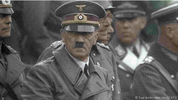
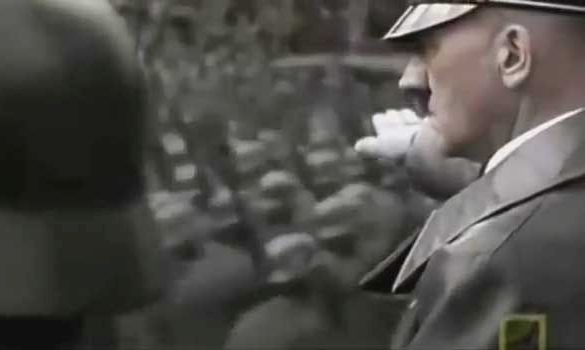
(Note: footage) ⟨The Führer advances solemnly through the crowd.⟩
A man destroyed by his immersion in the Hitler myth: Joseph Goebbels. In his youth he was a sharp-minded nationalist and writer. Yet few recognized his talent—until he met Hitler.
〈From Goebbels's diary〉‘November 6, 1925. Hitler's star-like blue eyes welcomed me joyfully when I visited. I felt as though I were in heaven. His hand clasped mine. With wit, irony, humor and seriousness, Hitler talked on and on. This man is fit to be king. A born leader, the future dictator.’
His life was decided at that moment.
T. Junge, Hitler's secretary at the time: “Hitler valued Goebbels very highly, as a loyal subordinate and a perfect National Socialist. He also appreciated his ability as propaganda minister. But I never saw them have a friendly conversation. At least to me, as Hitler's secretary then, their relationship appeared purely professional.”
In 1926, at Hitler's request, Goebbels took command of the SA in Berlin. Through extreme violence he made the Nazi name widely known and earned recognition. For the first time, Goebbels felt that his opportunity in life had arrived. He was filled with ambition. He wanted only one thing: to stand on a platform and command attention.
S. Russell, then a correspondent in Berlin: ‘Goebbels was a thin, small man with a disproportionately large head, and his gestures and movements looked somehow awkward. What most caught our attention was his energetic speaking, never silent for an instant. On the platform he talked as if possessed. Yet there was something about him like a marionette manipulated by power.’
Valued for his sharp oratory, Goebbels waged a ruthless war of words as the party's election campaign leader.
[Note: television footage of Goebbels] <1932: 'We will surely rescue the people from despair. Without Nazi power, there can be no hope for Germany's future.'>
Book Burning
In 1933, immediately after the Nazis seized power through intimidation and propaganda, Goebbels began a large-scale assault on free expression.
⟨In May 1933, Goebbels ordered the burning of un-German books.⟩
S. Russell, a correspondent in Berlin at the time: "Until then, I knew the term book burning only from history books. It was an act of oppression practiced in the distant Middle Ages, something I thought inconceivable in the twentieth century. Yet as soon as Hitler came to power, huge quantities of books were suddenly thrown onto fires in a Berlin square. We could only watch in astonishment. Standing before the flames was Goebbels, who had ordered it. His brightly illuminated expression was defiant. At that moment I felt there was something inhuman about him. He had originally been a journalist—an utterly unsuccessful, unrecognized writer. And once the Nazis gave him a stage, the very first thing he undertook was the persecution of journalists. I cannot help thinking it was personal revenge. Perhaps Goebbels savored victory as the books of his former rivals turned to ashes. He was astonishingly energetic. But I believe that energy was driven by feelings of inferiority toward others and by hatred."
Goebbels sought to give the nation a common object of hatred. The Jews were chosen.
(Note: Goebbels addressing an audience) [April 1, 1933] “The boycott of Jews began at ten in the morning and quickly spread through the streets. Disciplined conduct has prevented major disturbances.”
Antisemitic shouts. Young men attacking Jewish shops one after another. At their core was the SA under Goebbels's command. While silencing opponents through violence, Goebbels clothed the party's power in dazzling colors.
Goebbels’s Castle: Ministry of Public Enlightenment and Propaganda
(Note: Goebbels's speech): “I feel deeply honored to celebrate the topping-out ceremony here today.”
The newly established Ministry of Public Enlightenment and Propaganda was Goebbels's domain after he joined the cabinet in March 1933. From this building came a vast campaign to incite and indoctrinate the population. Its methods were exceptionally modern and sophisticated, but its messages lacked human warmth.
(Note: Goebbels’s voice) 〈‘There is a secret to ideological propaganda. Above all, its targets must not realize it is propaganda. Its intention must likewise be cleverly concealed. Saturate them with ideology without their knowing.’〉
Goebbels's skillful manipulation of speech gradually numbed the people to the reality that they were being controlled.
Journalist H. Borgelt: "Strange as it sounds, people at the time, myself included, felt society was relatively free. I believed I could write what I wanted. But years later, when I read what I had written then, I was appalled. The tone was as if I were standing rigidly at attention, awaiting orders. I realized that was censorship."
Goebbels placed the greatest importance on the power of film. The vast footage left after his death contains dazzling images that deceived the public and in which he himself became immersed.
(Note: introductory footage) [Film: Triumph of the Will, 1934]
Through gaudy ceremonies, the Nazis proclaimed that, in a chaotic world, order existed here alone. The party rally resembled a solemn mass, and the Führer played the high priest to perfection. For Goebbels, directing things behind the scenes, this propaganda was a Nazi masterpiece. But Propaganda Minister Goebbels was not content merely to orchestrate spectacular ceremonies out of sight. Being noticed mattered more to him than anything. So Goebbels came up with the idea of using his own family to improve the party's image. What was the ideal family in Germany's Third Reich? The propaganda minister himself volunteered to serve as the model.
(Note: footage) ⟨The Goebbels residence⟩
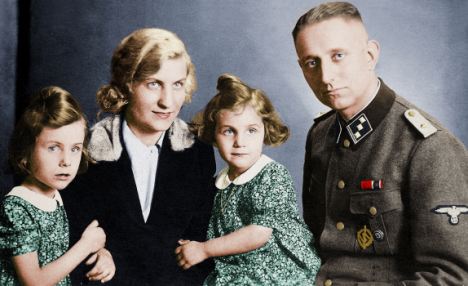
Goebbels's wife Magda came from an upper-class family and was also an ardent party member. They had six healthy children to carry Germany's future. It was precisely the model family that suited Hitler's tastes. Adorned with this image of domestic happiness, Goebbels staged the bright side of power. A yacht was one status symbol of the 1930s. Mindful of the public, Minister Goebbels apparently remarked that it was a somewhat expensive hobby.
Goebbels liked acting as the public face of the Party. On a visit to Italy, he was allowed to meet Mussolini as the representative of Hitler's state. It was an honorable assignment. Since Minister Goebbels had a duty to display a glamorous life to the public, he needed wealth to match. The city of Berlin therefore presented him with a country house. By his logic, this was not corruption but a mark of respect for the Party. A warm, prosperous family scene. Yet the children rarely spent time with their father. They believed what they were taught: that their father put service to the nation first.
Goebbels: The Human Being behind the Public Face
Yet while playing the exemplary husband and father, he also possessed a completely opposite side to his character.
(Note: Goebbels's voice) 〈“We love an open human nature more than rigid morality.”〉
When it came to surrounding himself with actresses and celebrities, Goebbels competed for first place in the party. Social gatherings with film actors. His position as propaganda minister served his purpose very well. That purpose, of course, was to enjoy romantic adventures.
Actress A. Ullrich: “The atmosphere at the party was relaxed, and Minister Goebbels seemed very much at ease. He complimented me on being a charming conversational partner. Then he suggested that we go for a drive together. When someone says that, could a person in my position possibly refuse? Perhaps sensing my nervousness, he was very kind. We sped along the autobahn and arrived at a holiday retreat with beautiful woods and lakes. There was a bungalow on a hill, and Goebbels stopped the car there. Someone opened the gate for us. It had a comfortable living room with a fire burning in the fireplace. After we had enjoyed a long conversation, he suddenly demanded that I have sex with him. I refused firmly. Of course, I had no idea what might happen to me afterward if I refused, but I could not make that sort of calculation. I behaved so hysterically that he finally gave up. With behavior like that, it will be hard for you to make it as an actress, he said. That was on a Friday. Then, either the following day or on Monday, I went to the studio. But the film we had been shooting had suddenly been canceled.”
(Note: film introduction) 〈A Prussian Love Story, 1938〉
Goebbels had affairs with dozens of actresses, but only one truly captivated him: the Czech-born Lída Baarová.
Actress L. Baarová: “What I wanted was his affection, not his position. He loved me deeply, and we gradually became immersed in our love for each other. But when he told his wife ⟨(Note: footage) Magda⟩, the next day she went to Hitler himself, saying she had something important to discuss. Her account was not truthful. She explained it as if I had seduced Goebbels for some ulterior purpose. So Hitler summoned Goebbels and sternly ordered him to break with me at once.”
<[Note: film dialogue] Woman: 'I feel everyone shuns me.' Man in uniform: 'Why worry about something so trivial? I'll speak to Father.'>
Actress L. Baarová: “When Hitler gathered his close associates at his mountain retreat, Goebbels was prepared to resign as minister and live with me. Magda already wanted a divorce. He wanted to leave his current post and become ambassador to Japan. He told me he would not mind even becoming a peddler there. With that resolve, he offered his resignation. Apparently Hitler flew into a terrible rage on hearing it, probably because he did not want to lose a capable subordinate. Once he calmed down, his decision sounded reasonable: live with your wife for three months and try to reconcile; if that failed, he would allow a divorce. But I do not think he meant it. He was only looking for a pretext to separate Goebbels and me. The three-month limit meant nothing.”
(Note: Film dialogue) Man in uniform: “Eight weeks apart is too painful for me.” Woman: “Time always passes.”
Hunger for Power—Return to Loyalty
A love scandal between a married minister with children and a Czech woman, just as Germany was maneuvering to acquire the Sudetenland: this greatly displeased Hitler. Goebbels had briefly intended to abandon fame and pursue his love, but Hitler's fury brought him back to reality. He chose loyalty to the Führer over love.
Hitler's aide at the time, R. Spitzy: “Hitler gave Goebbels an order that allowed no argument: send Baarová back to her hometown of Prague within forty-eight hours. Goebbels could only obey. But from then on Hitler kept him away from important occasions. His rival aides were secretly delighted to see it.”
W. von Oven, then Goebbels's adjutant: "Goebbels was so despondent that even his subordinates noticed. He was no longer invited to the customary meals at the Chancellery and was pushed into the shadows in every respect. I realized how dependent he was on Hitler and Hitler's power. Like an alcoholic craving a drop of liquor, he hungered for power and seemed almost to writhe in desperation."
The Orator's Return
In November 1938, a young Jewish man shot dead a German diplomat in Paris. As soon as the news arrived, antisemitism in Germany erupted.
R. Spitzy, then Hitler's adjutant: "For Goebbels, who had fallen on hard times, it was a unique chance to remind Hitler of his existence. He wanted to show that he was still the perfect Nazi. As soon as news came of the German diplomat's assassination, he called out the Berlin SA and unleashed them on the streets. He let these rough young men, burning with antisemitism, run riot as they pleased. The uniformed men attacked Jewish shops with the savagery of wild dogs."
⟨From Goebbels's diary: “November 10, 1938. At the party commemorative gathering in Munich, I reported the diplomat's shooting to the Führer. The Führer ordered: Let spontaneous demonstrations continue, and do not deploy the police. The Jews should feel the people's anger firsthand. The Führer is entirely right. I immediately issued instructions to the police and the party and gave a short speech before the party members. Thunderous applause. As I was about to leave, the sky was blood-red. A synagogue was burning. As long as the fire did not spread to the surrounding area, we let it burn itself out. Bravo.”⟩
Kristallnacht. From the glitter of shattered glass, someone gave this riot a name far too beautiful.
(Note: Goebbels's speech): “Beware and wait. Our patience has limits. One day we will silence the insolent Jews.”
Goebbels the orator was back.
April 1939, Hitler's fiftieth birthday. In the ruler's mind, war was already decided, but for a while he had his subordinate Goebbels play the messenger of peace.
[Note: footage of an interview with Goebbels] <'I believe peace in Europe must come first. War must be avoided at all costs. If Europe were engulfed in war, victors and vanquished alike would suffer.'>
War Begins; Persecution of Jews Intensifies
⟨September 1939: German troops invade Poland. War begins.⟩
As Hitler's armies ravaged the Polish plains, Goebbels stayed away from the front and continued firing verbal bullets.
(Note: Goebbels's voice) [1940: "The overwhelming power of our Luftwaffe has destroyed the stronghold of the sinful."]
Branded guilty, Jews were ruthlessly herded into camps. Goebbels’s racial hatred grew still more extreme when he confronted Polish Jews.
[From Goebbels's diary: "November 2, 1939. I inspected the ghetto. What hideousness. They are not human beings, but animals. Therefore this is not a humanitarian question but a sanitary task. It should be solved in one stroke, with the utmost thoroughness."]
F. Hippler, then head of the Reich Film Directorate: “In 1939 or 1940, a weekly newsreel from the early war years contained footage of Jews in Poland. Goebbels watched it with Nazi leaders. As soon as it ended, the first thing he said was: I cannot bear to think of those Jews ever returning to Germany. Even if we should lose the war, that alone would be utterly unacceptable. I have discussed it with my wife from time to time. Rather than share our homeland with Jews, my wife and I would choose suicide. He said that quite explicitly. Goebbels could not contain his agitation and kept hurling abuse at Jews. He also said things like: look at those faces, the faces of genuine criminals.”
Children in the ghetto. Were these children criminals too? Then comes strikingly contrasting footage of children: the ideal Germany promoted by Goebbels. General Rommel, Germany's most popular general, appears in the film as the children's friend.
Honing His Eloquence
⟨June 1940: France surrenders⟩
In June 1940, Germany forced France to surrender. No propaganda is stronger than victory. Goebbels lavishly praised Hitler’s genius. Even when Hitler proposed the dangerous two-front war in east and west, Goebbels trusted his master’s intuition. He tried to act more soldierly and courageous than the soldiers themselves.
June 1941. Hitler gave him the honor of announcing the beginning of the war against the Soviet Union.
(Note: News footage): “Minister Goebbels will now read the Führer's statement.”
Goebbels chose his words with great cunning. What he called a war for freedom was actually a war of annihilation. Preventive war meant aggressive war. Words were increasingly used to suppress the facts.
(Note: newsreel) ["The resolute attack forestalled the barbaric enemy."]
Goebbels’s venomous eloquence grew still more polished during the war.
(Note: Goebbels's voice) “National Socialism will bring peace and culture to all Europe. But to achieve that ideal, we must crush by force the conspiracy of the inferior Jewish race.”
Previously unreleased footage filmed at a prisoner-of-war camp. Minister Goebbels wears a cold expression as he faces the prisoners. He is becoming dissatisfied with merely isolating Jews.
Accelerating the Internment and Extermination of Jews
〈In 1941, the Nazis began deporting Jews to the east.〉
[From Goebbels's diary: "August 20, 1941. I intend to tackle the Jewish question actively. With the Führer's permission, we will make Jews wear identifying marks. We will now be able to act swiftly without relying on legal papers. The Jews will soon disappear from our streets. We will expel them from society."]
I. Deutschkron, a German Jew: "I had my pride. I felt like holding my head high with the badge on my chest and saying, 'Look, I am a Jewish woman.' Not everyone in the streets was prejudiced. Some even slipped goods to me in a crowd, because Jews struggled even to do their daily shopping. But I can never forget the hatred in so many people's eyes and the terrifying acts that resembled medieval witch hunts."
January 1942. Leading Party and government figures confirmed and coordinated the “Final Solution of the Jewish Question”: the extermination of the Jewish people.
〈From Goebbels's diary: ‘March 27, 1942. Jews are being deported eastward from Poland. Quite harsh methods are being used at their destination, and not many are left now. The rough estimate is confirmed as follows: about sixty percent are liquidated, and only forty percent can be put to work. The Jews fully deserve this severe punishment.’〉
German Jew I. Deutschkron: ‘Goebbels publicly spoke of expulsion, but in reality he had no intention of letting Jews remain alive anywhere.’
Looming Defeat—Total War
[Note: Goebbels's speech] <February 1943: 'Jewish evil infects society if left unchecked. Germany will not yield to Jewish threats and will meet any kind of battle. We are prepared to fight thoroughly and completely until the Jews are extinguished.'>
He nearly revealed the Nazis' true aim: the extermination of the Jews. By 1943, the war was already going badly. The German army had been defeated at Stalingrad. Goebbels's message focused on a single point: an all-out effort. k
(Note: Goebbels's speech) 〈“The German government believes total war will lead us into the future. I ask the people: do you prefer submission to total war?” “No.”〉
Audience member S. Bebe: “Every time Goebbels asked a question, the men around me, their anger inflamed, shouted. At first Goebbels mourned the deaths of innocent women and children. Then, when the audience was burning with anger and sorrow, he directed their blame toward the conclusion he wanted. By the end the audience had lost all reason, and the entire hall was roaring.”
(Note: Goebbels’s speech) 〈‘Do you want total war?’ (The audience screams.)〉
B. Pomsel, then in the audience: ‘It was an unbelievable sight. Although people did not even clearly understand what “total war” meant, the enthusiasm and intoxication Goebbels whipped up put them into a kind of trance. When he asked, “Do you want total war?” the audience shouted, “Of course!” without an instant’s hesitation. I just stood there. It was a chilling experience. Then the men around me said sternly, “Applaud! Why aren’t you applauding?”’
(Note: Goebbels’s speech) 〈‘Let us rise together. The time has come to unleash a storm of assault.’ (Audience applause)〉
After the speech, Goebbels said: The audience would have jumped from the roof of a building if I had ordered it.
By the time people finally understood the true meaning of total war, no one could escape it. Even women were mobilized to fight fires. Yet nothing could be done against the repeated air raids. Germany's cities were dying. But the instigator of total war behaved with ever greater vigor. Goebbels no longer had victories to offer, only slogans demanding that people fight to the bitter end. At least he went out to encourage the population. The Führer he praised had not once visited the ruins. Even Goebbels now sometimes doubted victory. But showing weakness was forbidden. Hitler berated his subordinates, insisting that total war had still not gone far enough.
H. Hunke, then head of the foreign propaganda organization: "Goebbels had almost no influence over strategic decisions. I often saw him excitedly enter Führer Headquarters carrying an elaborate plan. But when he came back out—well, he looked like a poodle that had been drenched with water."
The Final Propaganda
⟨July 20, 1944: Attempt to assassinate Hitler⟩
The attempted assassination of Hitler. The effort to overthrow the dictator from within the power structure had failed. Amid the confusion, Goebbels showed the most devoted loyalty of all his inner circle. The Führer, who had scarcely listened to his plans before, now placed special trust in him. This faithful servant was given full authority to mobilize Nazi Germany for total war. His overriding task was to send as many people as possible to the battlefield. For the first time, he inspected the front on a military mission. Weapons and ammunition were already running out, but he remained as defiant as ever.
(Note: Goebbels addressing elderly and boy soldiers) ["Every division is solemnly carrying out its duty. To you who are about to launch the general assault, I offer this advice: serve with the devotion you bring to Mass. Your brave cries will strike terror into the enemy."]
The Hitler Youth. These thoroughly indoctrinated boy soldiers, too, went to war.
(Note: Goebbels's voice): “An indomitable spirit dwells in the German people. Not only the men, but their wives and children too are heroes.”
F. Neuhüttler, then a soldier guarding the Reich Chancellery: "Even at the very end, when not a shred of hope remained, Goebbels was still driving young people to their deaths. I think his responsibility was immeasurable. Without such relentless propaganda, some people might have realized the truth a little sooner. But most of the population had been convinced that defeat meant either execution or slavery for everyone. Goebbels manipulated the media to drum that image into us repeatedly: the only way we could go on living as Germans was to fight our way through. We felt cornered."
Sensing the final day approaching, Goebbels buys time with words.
(Note: Goebbels's voice) ["We will fight on even drenched in blood. Rather than be occupied and subjugated by the enemy, we choose to breathe our last on the battlefield."]
〈April 1945, final radio address: ‘Berlin has become a frontline city. The designs of the barbarous enemy will be shattered here. Agitators who disrupt the unity of the citizens will be arrested and executed immediately. It goes without saying that we leaders will remain in Berlin. I will stay in the city with my wife and children.’〉
W. V. Oven, then Goebbels's aide: “While I was visiting Goebbels's room, a shell struck a rock right beside the building. The force of the explosion was tremendous. Not only did the windows shatter, but we were hit by a powerful blast. Part of the wall broke and plaster dust flew everywhere. Yet when I looked up, Goebbels was still reading the document he had been holding. He kept reading with a completely blank expression, brushing away dust and glass with his right hand. It gave me a shock.”
As Stalin's army approached the heart of Berlin, Goebbels was closer than ever to Hitler in the bunker. He wanted to share the Führer's fate to the very end.
Sharing Hitler’s Fate
T. Junge, Hitler's secretary at the time: “I was startled when Goebbels suddenly appeared. He was deathly pale and his eyes were full of tears. He probably wanted to pour out his feelings to someone. There were few people he could speak openly to, and I think he happened to choose me, a secretary. ‘Miss Junge, the Führer wants me to leave here and see what becomes of Berlin. He says I should be useful in a future government. But I cannot leave him.’ He felt he was the subordinate most completely at one with Hitler. Goebbels seemed interested in nothing but fulfilling his loyalty.”
Goebbels stayed and summoned his wife and children to the bunker, knowing the cruel end that awaited them.
(Note: Goebbels's children singing) ⟨“No matter how busy Daddy is, Daddy is my very best friend.”⟩
R. Misch, telephone operator in the Führerbunker: “Yes, of course, there was a painful drama in that bunker. I appealed to many people to try to save at least the children. Even the kitchen and office staff pleaded with Mrs. Goebbels for their lives. But in the end, she would not listen. On the final day, Mrs. Goebbels prepared her six children for the last time. She dressed them in pure white, combed their hair, and then they were gone.”
F. Neuhüttler, then a Reich Chancellery guard: “Suddenly I saw Goebbels rubbing his hands together and muttering, ‘We march for Adolf Hitler.’ Then he began to sing. It was chillingly eerie. In the end, he kept talking about the same thing until he died.”